Book Appointment Now

Vestibular Rehabilitation in Milton
Vestibular rehabilitation in Milton for vertigo, BPPV and balance loss: assessment, repositioning and a home program. Pickering patients referred.
Vestibular rehabilitation is exercise-based physiotherapy for dizziness, vertigo and balance problems that start in the inner ear or the balance pathways of the brain. It is not a pill and it is not a single manoeuvre. An assessment identifies which pattern you have, then a targeted home program retrains the system over weeks. At Pro Fusion Rehab the program runs at our Milton clinic, and Pickering patients are assessed locally and referred there.
Key takeaways
- Vestibular rehabilitation is exercise-based treatment for vertigo, unsteadiness and gaze instability; a repositioning manoeuvre alone does not retrain the system.
- BPPV is the fastest pattern to settle: canalith repositioning usually resolves it in 1 to 3 visits over 1 to 2 weeks.
- Unilateral hypofunction, vestibular neuritis recovery and PPPD need longer programs, typically 6 to 16 visits across 6 to 12 weeks.
- Positional testing (Dix-Hallpike and the roll test) is what separates BPPV from the other patterns.
- The daily home program drives recovery between visits; skipping it flattens the result.
- Milton is where we deliver this program. Pickering patients can be assessed locally and referred.
- Get urgent care if vertigo arrives with new weakness, double vision, slurred speech or a sudden severe headache.
What vestibular rehabilitation actually treats
Your balance system runs on three inputs: the inner ear, your eyes, and the position sense from your joints and feet. When one input is damaged or sending wrong information, the brain can recalibrate, but only if it is given the right kind of movement practice. That is what rehabilitation does, and it is why rest and medication alone rarely fix a persistent balance problem.
The three mechanisms we train
Every exercise we prescribe targets one of these, which is why a generic balance video is not a substitute for an assessment.
- Adaptation: repeated head movement while the eyes stay fixed on a target teaches the vestibulo-ocular reflex to work again.
- Habituation: controlled, repeated exposure to the movements that provoke symptoms teaches the brain to stop over-reacting to normal motion.
- Substitution: balance and gait drills train the visual and proprioceptive systems to cover for an inner ear that no longer contributes normally.
Typical symptoms and common causes
Symptoms that point to a vestibular problem
- Spinning vertigo, brief or prolonged, often triggered by a change in head position.
- Unsteadiness, a feeling of drifting or being pulled to one side when standing or walking.
- Motion sensitivity, such as nausea in a busy supermarket or while scrolling.
- Gaze instability, where the world keeps moving or blurs when you turn your head.
- Nausea, sweating and fatigue that come with the dizziness rather than on their own.
Causes we see most often
- BPPV (benign paroxysmal positional vertigo), where displaced crystals in the inner ear cause brief spinning with head changes.
- Vestibular neuritis, inflammation of the vestibular nerve causing sudden prolonged dizziness.
- Unilateral vestibular hypofunction, reduced function in one inner ear.
- PPPD (persistent postural-perceptual dizziness), chronic non-spinning dizziness lasting three months or more.
- Head trauma, falls, and age-related vestibular decline.
Which pattern you have changes the plan
Two people with the same description of dizziness can need completely different programs. The ranges below are typical, not fixed: your physiotherapist adjusts both frequency and duration as your symptoms respond.
| Type of problem | Typical number of visits | Typical duration | Visit frequency |
|---|---|---|---|
| BPPV | 1 to 3 visits | 1 to 2 weeks | Weekly |
| Unilateral hypofunction | 6 to 12 visits | 6 to 8 weeks | 1 to 2 times weekly |
| Vestibular neuritis recovery | 8 to 16 visits | 8 to 12 weeks | 1 to 2 times weekly |
| PPPD | 8 to 16 visits | 10 to 12 weeks | 1 to 2 times weekly |
What the first assessment involves
The first appointment is an assessment, not a treatment session. We need to know which system is producing the dizziness before anything is prescribed.
| Assessment step | What it checks | Time |
|---|---|---|
| History taking | Symptom onset, triggers and medical background | 15 minutes |
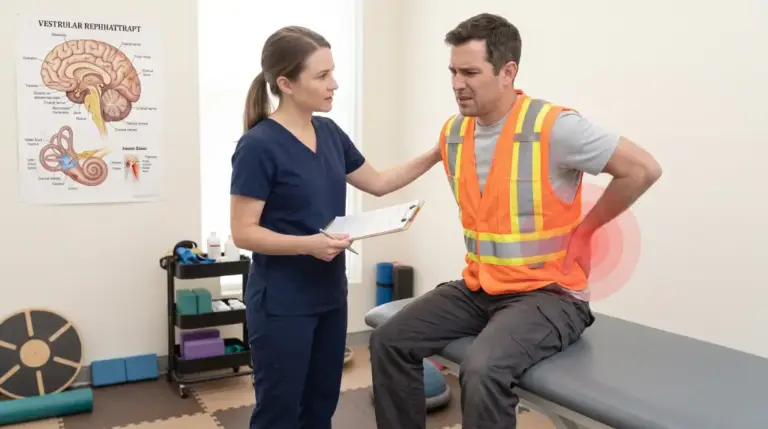
| Positional testing | Presence of BPPV with the Dix-Hallpike or roll test | 10 minutes |
| Gaze and oculomotor testing | Eye-head coordination and tracking ability | 10 minutes |
| Balance and gait assessment | Postural stability and walking mechanics | 10 minutes |
Positional testing is the part that changes everything downstream. If the crystals are displaced, a repositioning manoeuvre can settle the problem in one to three visits. If they are not, you are looking at an adaptation or habituation program instead, and the timeline is measured in weeks.
Treatment at Pro Fusion Rehab in Pickering and Milton
Vestibular rehabilitation, concussion rehabilitation and manual lymphatic drainage are delivered at our Milton clinic. Pickering patients are assessed at their local clinic and referred to Milton for this specific care, so the trip is planned rather than repeated weekly by default.
- Registered physiotherapy with positional testing, canalith repositioning, gaze stabilization and balance training in one plan.
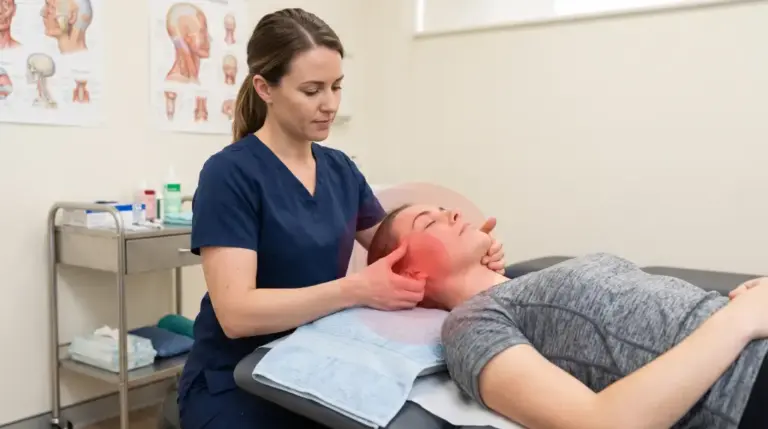
- Registered massage therapy for the neck and upper back tension that can add a cervicogenic component to an inner-ear problem.
- Acupuncture for patients whose nausea or dizziness intensity is the limiting factor.
- Concussion rehabilitation for dizziness that persists after a head injury. General vertigo assessment is also covered on our vertigo relief page.
Our Pickering clinic is at 1885 Glenanna Road, Unit 112, Pickering, ON L1V 6R6, phone (905) 492-2577, and has served the community since March 2011. Our Milton clinic is at 470 Bronte Street South, Unit 200, Milton, ON L9T 2J4, phone (289) 878-8881, and has been open since 2015. Osteopathy is not available in Milton. Direct billing is available to most major insurers, and approved WSIB and auto insurance claims are billed directly as well.
Home exercises that do the work
Between visits the program is yours. Your physiotherapist selects movements for your findings and tells you how often to repeat them; the list below is the shape of a typical program, not a prescription.
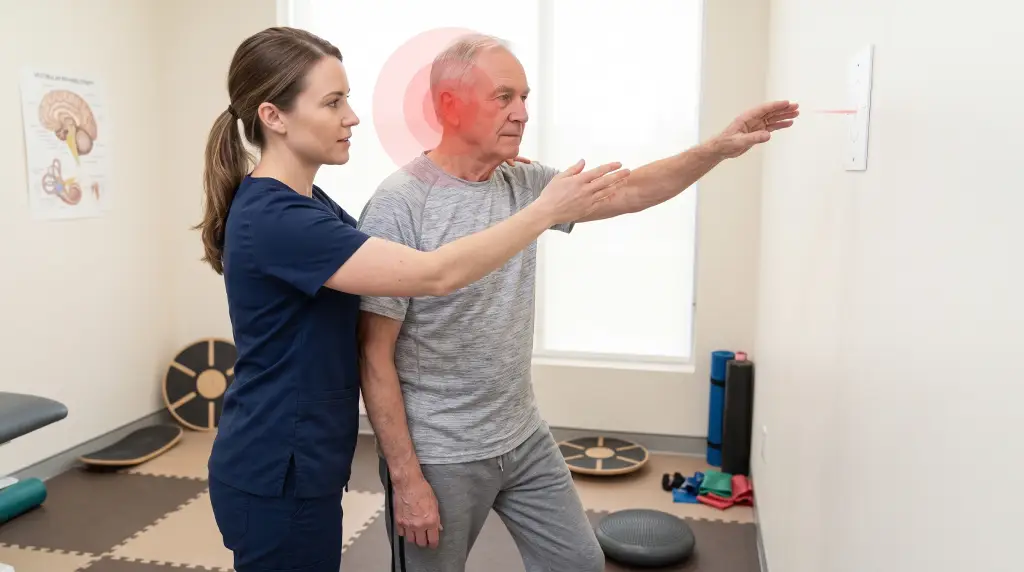
- Gaze stabilization (VOR x1): keep your eyes on a target while turning your head side to side, then up and down.
- Habituation head movements: repeat the positions that provoke mild symptoms so the brain adapts over time.
- Static balance: stand with feet together, then narrow your base, near a counter for support.
- Dynamic balance: walk with head turns, or heel to toe along a hallway.
- Repositioning manoeuvres: perform these at home only if your clinician has instructed them for BPPV.
When to see someone in Pickering or Milton
Book an assessment if dizziness is changing what you do day to day: avoiding driving, avoiding crowds, holding walls, or sleeping propped up. You do not need imaging or a specialist referral first, and you do not need to wait for it to settle on its own.
Get urgent medical care instead of booking physiotherapy if vertigo comes with any of these:
- New weakness or numbness in the face, arm or leg.
- Double vision, slurred speech, or difficulty swallowing.
- A sudden severe headache unlike anything before.
- Hearing loss that appeared with the dizziness.
FAQ
Will the exercises make me dizzy?
Some vestibular exercises temporarily provoke mild, short-lived dizziness because they challenge the system that needs to adapt. That reaction is expected and usually fades within 20 to 30 minutes. Your physiotherapist monitors your tolerance and adjusts the dose so it stays manageable.
How long does vestibular rehabilitation take?
It depends on the pattern. BPPV often settles in 1 to 3 visits over 1 to 2 weeks. Unilateral hypofunction, vestibular neuritis recovery and PPPD usually need 6 to 16 visits across 6 to 12 weeks, with daily home practice in between.
Can I drive myself to the appointment?
For the first visit, arrange a ride. Positional testing can provoke strong dizziness, and driving while symptoms are active is unsafe. Most patients drive themselves to later visits once they know how they respond.
What should I bring to the first visit?
Bring a list of your medications, any imaging or specialist reports, and a written note of what triggers the dizziness and what you have stopped doing because of it. That history does more for the assessment than any test.
Is vestibular rehabilitation covered by insurance?
Most extended health plans cover physiotherapy, and direct billing is available to most major insurers. Approved WSIB and auto insurance claims are billed directly. Contact us with your plan details and we will confirm before your visit.
Do I need a doctor’s referral?
No referral is needed to book an assessment in Ontario. Some insurance plans require a prescription for reimbursement, so check your policy before the first visit.
Is it safe to do the exercises at home on my own?
Yes, once they have been prescribed for your pattern. The risk is doing the wrong exercise confidently: habituation drills do not help BPPV, and repositioning manoeuvres done incorrectly do not clear the canal. Start with an assessment.
Where is vestibular rehabilitation offered?
At our Milton clinic. Pickering patients are assessed at the Pickering clinic and referred to Milton for vestibular rehabilitation, concussion rehabilitation and manual lymphatic drainage.
Our physiotherapy team in Pickering and Milton assesses and treats vestibular problems weekly. You can book an appointment online with no referral needed, or contact us if you are not sure whether your dizziness fits this program.