Book Appointment Now

TMJ Treatment at Pro Fusion Rehab
TMJ physiotherapy in Pickering and Milton: mouth-opening assessment, manual therapy, jaw exercise and habit changes that ease clenching pain.
Jaw pain, clicking and limited opening usually come from the temporomandibular joint and the muscles that move it, not from the teeth. Physiotherapy for TMJ disorder measures how the jaw actually moves, releases the muscles holding it guarded, and rebuilds control so eating and talking stop hurting. Both Pro Fusion Rehab clinics in Pickering and Milton treat it, and we coordinate with your dentist when dental or surgical care is needed.
Key takeaways
- TMJ disorder is usually multifactorial: joint mechanics, muscle guarding and daily habits reinforce each other.
- Clicking alone is not a diagnosis; limited opening, pain with chewing and morning jaw ache matter more.
- Physiotherapy does not replace dental care and does not diagnose dental disease; suspected disc or occlusal problems are referred to a dentist or oral surgeon.
- Most muscular cases need 6 to 8 visits over 4 to 6 weeks; chronic clenching-related pain runs 8 to 12 visits.
- Home care is load management: softer food during flares, no gum, and a resting jaw posture.
- Get assessed if the jaw locks, your bite feels different, or opening keeps shrinking.
What TMJ disorder actually is
The temporomandibular joint connects your jaw to your skull, just in front of each ear. It slides and rotates at the same time, which makes it one of the few joints in the body that depends on muscle coordination as much as on joint surfaces. When the muscles that close the jaw stay guarded, or the disc inside the joint is displaced, movement becomes painful and restricted.
Muscular versus joint-driven problems
Muscular TMD shows up as diffuse ache over the masseter and temple, worse with clenching and at the end of the day. Disc displacement with reduction produces a click on opening or closing. Disc displacement without reduction produces a locked, persistently limited opening. The three respond to different programs, which is why the assessment measures millimetres rather than relying on description.
Typical symptoms and common causes
Symptoms we assess every week
- Clicking or popping when opening or closing the mouth.
- Limited opening, or a jaw that deviates to one side.
- Pain with chewing, yawning, or biting into hard food.
- Cheek, temple or ear pain on one or both sides.
- Headaches, ear fullness or ringing that tracks with jaw use.
Why jaws become painful
- Clenching and grinding (bruxism), often during sleep or under stress.
- Disc displacement inside the joint, producing clicking or catching.
- Direct trauma, prolonged dental work, or sustained wide opening.
- Forward head posture and neck strain that alter jaw muscle loading.
- Stress-related guarding of the masseter and temporalis muscles.
What the first assessment involves
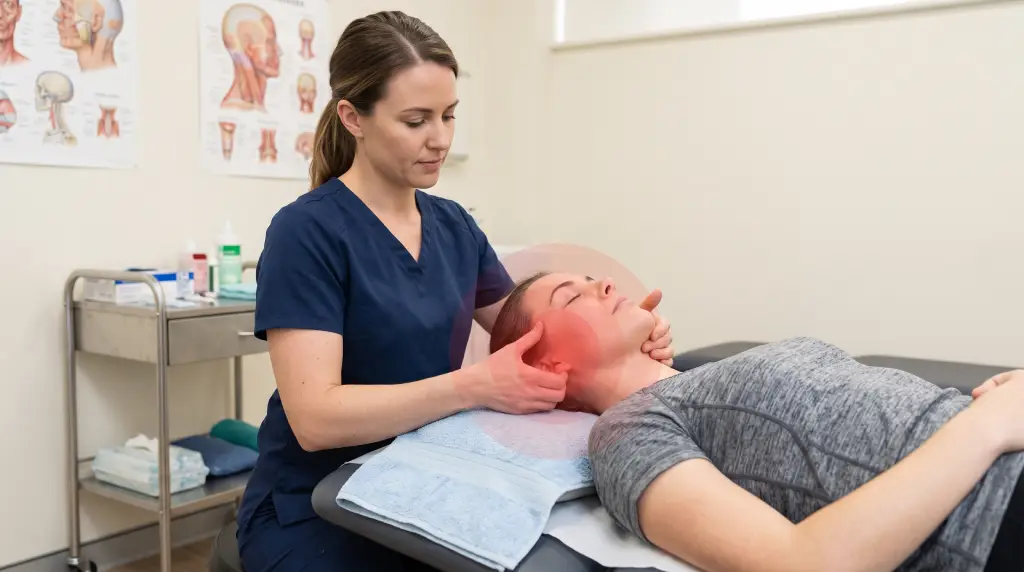
The first appointment is an assessment, not a massage. We measure how your jaw moves, find which structures are tender, and look at the neck and posture that feed into jaw mechanics.
| Assessment | What it tells us | Typical finding |
|---|---|---|
| Mouth opening measurement | Quantifies restriction in millimetres | Under 40 mm often indicates restriction |
| Joint and muscle palpation | Identifies tenderness and tension | Pain in masseter or lateral pterygoid |
| Cervical and posture check | Evaluates upper spine contribution | Forward head posture affecting jaw tracking |
| Parafunctional history | Reveals daily stress and habits | Daytime clenching or night grinding |
How physiotherapy treats it
Treatment combines hands-on work, exercise and habit change. Most plans start by reducing muscle guarding, then rebuild jaw control and load tolerance. Physiotherapy does not replace dental or oral surgery treatment, and it does not diagnose dental disease.
- Intra-oral and myofascial release: targeted work on the masseter, temporalis and lateral pterygoid restores comfortable opening.
- Joint mobilization: graded mobilization restores opening range and lateral movement without forcing the disc.
- Jaw control and tongue posture: controlled opening and tongue-to-palate loading rebuild tolerance for talking and chewing.
- Habit and ergonomic retraining: chewing side, sleep position and daytime clenching awareness keep the gains between visits.
Care plans at a glance
Ranges below are typical. Your physiotherapist sets the actual frequency after the assessment.
| Presentation | Typical number of visits | Typical duration | Visit frequency |
|---|---|---|---|
| Muscular TMD | 6 to 8 visits | 4 to 6 weeks | Weekly |
| Disc displacement with clicking | 4 to 8 visits | 4 to 8 weeks | Every 1 to 2 weeks |
| Post-dental-work jaw stiffness | 3 to 6 visits | 3 to 4 weeks | Weekly |
| Chronic clenching-related pain | 8 to 12 visits | 8 to 12 weeks | Every 1 to 2 weeks |
Treatment at Pro Fusion Rehab in Pickering and Milton
Both clinics assess and treat jaw pain, and both coordinate with your dentist or oral surgeon when dental or surgical care is required.
- Registered physiotherapy: opening measurement, intra-oral release, joint mobilization and a graded jaw program.
- Registered massage therapy: release of the masseter, temporalis and neck muscles that keep the jaw guarded.
- Acupuncture: an option for jaw and facial pain where it fits your plan.
- Dental and surgical referral: suspected dental, occlusal or disc pathology goes to a dentist or oral surgeon.
Our Pickering clinic is at 1885 Glenanna Road, Unit 112, Pickering, ON L1V 6R6, phone (905) 492-2577, serving the community since March 2011. Our Milton clinic is at 470 Bronte Street South, Unit 200, Milton, ON L9T 2J4, phone (289) 878-8881, open since 2015. Osteopathy is not available in Milton. Direct billing is available to most major insurers, and approved WSIB and auto insurance claims are billed directly.
Home care and exercises between visits
Home care for TMD is mostly load management and habit awareness. Your physiotherapist will tell you which of these apply to your case.
- Choose softer food during a flare: hard, chewy and crunchy foods load the joint far more than most people expect.
- Avoid maximum opening: support your jaw when yawning, cut food smaller, skip chewing gum.
- Rest the jaw between meals: lips together, teeth apart, tongue resting on the palate.
- Controlled opening: open slowly to a comfortable end range, hold five seconds, repeat ten times.
- Posture reset: chin tuck and shoulder-blade setting hourly at a desk takes load off the jaw muscles.
When to see someone in Pickering or Milton
Book an assessment if jaw pain is changing what you eat, if opening keeps shrinking, or if you wake with jaw or temple pain. You do not need imaging or a dental referral first.
Get urgent care if any of these happen:
- Your jaw locks open or closed and will not release.
- Your bite feels different after an injury or a dental procedure.
- There is swelling, fever, or pain that keeps worsening despite rest.
- You have jaw pain after a direct blow to the face.
FAQ
Do I have TMJ or TMD?
Both terms get used. TMJ is the joint itself; TMD is the disorder. Clinically we assess the joint, the muscles and the neck, then name the pattern rather than the joint.
Is clicking a problem?
Not on its own. Many people click without pain, and the click is often a disc reducing normally. Clicking with pain, locking or shrinking opening is what needs assessment.
Will physiotherapy fix my bite?
No. Bite changes are dental territory. Physiotherapy addresses muscle guarding, joint mobility and movement control, and we refer occlusal problems to your dentist.
Do I need an MRI before treatment?
Usually not. The assessment measures opening, palpation findings and movement quality, which identifies most patterns. Imaging is considered when the presentation is unclear or surgery is on the table.
How many visits will I need?
Muscular TMD typically needs 6 to 8 visits over 4 to 6 weeks. Chronic clenching-related pain runs 8 to 12 visits over 8 to 12 weeks. Your plan is reviewed as you progress.
Can I still wear my night guard?
Yes, and it usually helps. Tell your physiotherapist you wear one, because a guard changes how much clenching load reaches the joint overnight.
Does massage help jaw pain?
Massage of the masseter, temporalis and neck muscles reduces guarding and makes exercise easier. It works best alongside joint work and habit change, not instead of them.
Is TMJ treatment covered by insurance?
Physiotherapy for TMD is covered by most extended health plans, and direct billing is available to most major insurers. Approved WSIB and auto insurance claims are billed directly as well.
Our clinicians in Pickering and Milton assess jaw pain weekly and will tell you at the first visit which pattern you have, what it usually takes, and what to stop doing in the meantime. You can book online with no referral needed, or contact us first.