Book Appointment Now

Concussion Recovery
Concussion Recovery: Symptoms, Evidence-Based Care, and Safe Rehabilitation

In short: a concussion is a temporary disturbance of brain function after a blow or a sudden jolt, and it is managed by controlled return to activity rather than by resting in a dark room. Most people recover in two to four weeks with three to six guided visits, and the first step back is usually light daily activity within 24 to 48 hours. Symptoms beyond four weeks are common and treatable – they are not a sign that you are permanently damaged. When the head moves rapidly, the brain shifts within the skull. This mechanical force triggers a temporary metabolic energy crisis and disrupts neural communication. Consequently, individuals experience physical, cognitive, and emotional symptoms that interfere with work, school, and daily living.
At Pro Fusion Rehab, our experienced clinical team at our Milton clinic provides comprehensive concussion rehabilitation. Concussion rehabilitation is provided at our Milton location, and patients in Pickering can be assessed at our Pickering clinic and referred. We integrate registered physiotherapy, registered massage therapy (RMT), and acupuncture to support safe recovery and restore daily function.
At Pro Fusion Rehab, our experienced clinical team at our Milton clinic provides comprehensive concussion rehabilitation. Concussion rehabilitation is provided at our Milton location, and patients in Pickering can be assessed at our Pickering clinic and referred. We integrate registered physiotherapy, registered massage therapy (RMT), and acupuncture to support safe recovery and restore daily function.
Typical Symptoms & Common Causes of a Concussion
Concussion symptoms rarely look identical in two individuals. Furthermore, symptoms may emerge immediately after trauma or evolve over several days:
- Persistent Headaches and Pressure: A dull ache or tension headache, often concentrated at the base of the skull.
- Dizziness and Balance Disturbances: A feeling of unsteadiness, disequilibrium, or trouble navigating crowded spaces.
- Visual Disturbances and Light Sensitivity: Blurry vision, difficulty reading screens (photophobia), or eye strain when shifting visual focus.
- Cognitive Fatigue and “Brain Fog”: Slowed processing speed, trouble concentrating, and memory lapses during standard tasks.
- Sleep Disruption and Irritability: Trouble falling asleep, unrefreshing sleep, mood swings, or heightened emotional reactivity.
A concussion does not require direct head contact or a loss of consciousness. Rather, any high-velocity force transmitted to the head can cause it:
- Motor Vehicle Collisions: Sudden whiplash forces during rear-end or lateral vehicle collisions transmit rotational force into the brainstem and cervical spine.
- Sports Impacts: Direct body checks, heading a soccer ball awkwardly, or colliding with equipment in hockey or basketball.
- Slips and Falls: Slipping on ice, tripping over obstacles, or falling down stairs causes sudden ground impact.
- Workplace Trauma: Being struck by falling objects or sudden head jarring on construction and industrial job sites.
- Secondary Cervical Spine Sprains: Concurrent neck ligament or muscle strains (whiplash) frequently mimic and magnify primary concussion symptoms.
Looking for Concussion Relief?
Old advice recommended resting in a dark room for days until all symptoms vanished. However, current clinical evidence confirms that prolonged isolation delays recovery. Instead, structured, progressive care delivers the best outcomes:
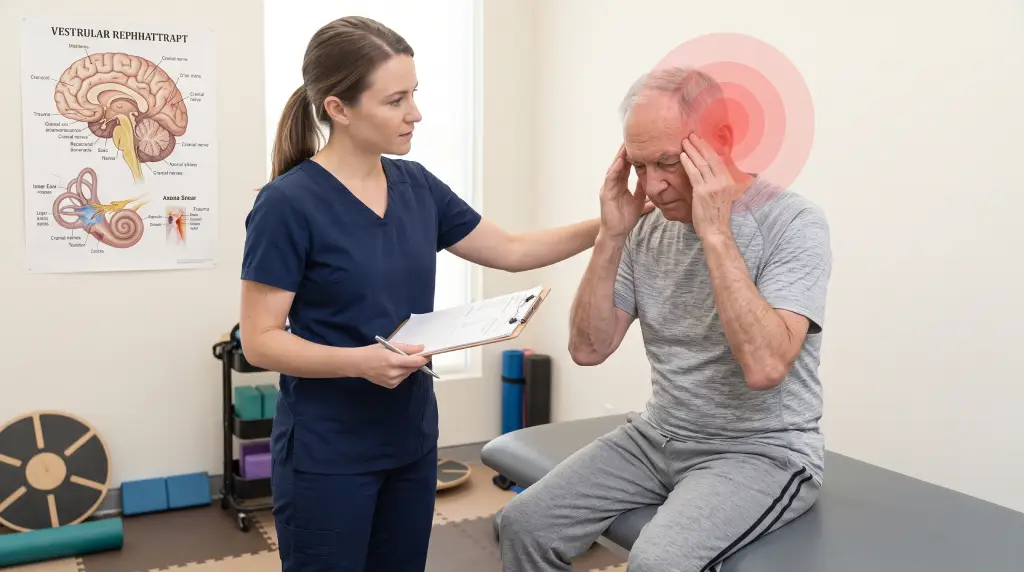
- Observe a Brief Rest Window: Limit cognitive and physical exertion for only the first 24 to 48 hours following the injury.
- Reintroduce Sub-Symptom Activity Early: Gentle walking promotes cerebral blood flow without provoking symptom spikes.
- Pace Screen Exposure: Break up screen use with 10-minute breaks to give fatigued visual pathways time to rest.
- Maintain Regular Sleep and Hydration: Stick to consistent bedtimes and drink water steadily to support brain cellular metabolism.
- Seek an Early Clinical Assessment: Concussions involve overlapping systems. Therefore, an early clinical evaluation prevents protracted post-concussion symptoms.
How Can Physiotherapy Treat a Concussion?
A Registered Physiotherapist evaluates your cervical spine, visual tracking, balance control, and autonomic function. After that, your therapist creates an individualized, phased rehabilitation plan.
Key clinical approaches include:
Key clinical approaches include:
- 1. Cervical Spine Rehabilitation and Manual Therapy: Treating co-existing neck dysfunction is critical. Gentle joint mobilizations and suboccipital soft tissue release reduce tension headaches, neck stiffness, and referred dizziness.
- 2. Vestibular and Balance Retraining: Specific head-body movement drills recalibrate inner ear balance pathways. Consequently, unsteadiness and motion-induced dizziness decrease.
- 3. Oculomotor and Vision Therapy: Targeted visual tracking and convergence exercises retrain the eye muscles. This eases screen-related eye strain and restores reading comfort.
- 4. Sub-Symptom Aerobic Conditioning: Controlled cardiovascular exercise on a stationary bike stimulates brain healing. Therapists use heart rate tracking to rebuild physical stamina safely.
Home Exercises and Remedies for Concussion Relief
Gentle home exercises support recovery between clinic appointments. Always perform these movements within a comfortable range and pause if symptoms increase:
- Gentle Cervical Range of Motion: Sit upright in a supportive chair with shoulders relaxed. Slowly turn your head to look over your right shoulder, hold for 2 seconds, and smoothly turn left. Complete 5 slow repetitions per side to prevent neck stiffness.
- Gaze Fixation on a Stationary Target: Hold your thumb at eye level about an arm’s length away. Keep your eyes focused on your thumbnail while slowly turning your head left and right for 15 seconds. Stop if you experience headache spikes or dizziness.
- Diaphragmatic Breathing Breaks: Lie comfortably on your back with one hand on your chest and one on your abdomen. Breathe in through your nose for 4 seconds, letting your belly rise, then exhale slowly for 6 seconds. Complete 5 cycles to downregulate your nervous system.
- Suboccipital Towel Rest: Roll a small hand towel and place it beneath the base of your skull while resting flat. Relax for 10 minutes to ease upper neck muscle guarding.
- Short Daily Walks: Take a 10- to 15-minute walk on a flat, quiet sidewalk daily. Low-intensity walking stimulates cerebral circulation without overloading sensory systems.
Concussion Clinic at Pro Fusion Rehab (Milton Clinic)
At Pro Fusion Rehab, our multidisciplinary team coordinates care to deliver efficient recovery:
- Registered Physiotherapy: We provide cervical spine treatment, vestibular rehabilitation, visual tracking drills, and guided return-to-work protocols.
- Registered Massage Therapy (RMT): Our therapists relieve persistent muscle hypertonicity across the neck, upper back, and temporomandibular (TMJ) muscles.
- Acupuncture: We use neuro-functional acupuncture to downregulate nervous system tension, ease persistent headaches, and improve sleep quality.
- Gradual Return-to-Activity Guidance: We provide step-by-step clearance plans for a safe return to sports, school, and physical work.
What Does A Staged Treatment Plan Look Like?
Treatment runs in three phases. The pace is set by how long the symptoms have been present, how much load the area takes every day, and how well the first phase settles. Visits are counted from your assessment rather than sold as a package.
| Phase | Goal | What Treatment Involves | Typical Visits |
|---|---|---|---|
| Phase 1 – Symptom-Limited Activity (Days 0-7) | Keep daily activity without pushing symptoms past a mild level | Symptom and sleep review, light walking and daily tasks, screen and work pacing, neck assessment | 1-2 visits in the first two weeks |
| Phase 2 – Graded Exercise (Weeks 1-4) | Build heart rate tolerance and visual-vestibular tolerance | Sub-symptom-threshold aerobic exercise, vestibular and oculomotor drills, balance work, neck treatment | Weekly, then every two weeks |
| Phase 3 – Return To Sport Or Work (Weeks 4-8) | Full work, driving and sport without symptom relapse | Stepwise return-to-sport protocol, cognitive load progression, final review with your physician | 1-3 visits across the phase |
When Should You Go To The Emergency Department?
A concussion is usually safe to manage at home, but a small number of head injuries need emergency imaging. These are the ones – do not wait for a physiotherapy appointment.
- Any loss of consciousness, a seizure, vomiting repeatedly, a worsening headache, unequal pupils, or increasing drowsiness and confusion: call 911 or go to the emergency department immediately.
- Weakness or numbness on one side, slurred speech, or vision loss: these are stroke-type signs after a head injury and need emergency assessment the same hour.
- The injury involved a fall from height, a vehicle crash, or blood thinners: the risk of bleeding is higher, so a medical assessment comes before any return to activity.
Once the emergency question is closed, we run the graded return. We do not clear anyone for sport or driving – that is your physician’s call – but we provide the test results and the progression they need to make it.
Concussion Care In Pickering
This service runs out of our Milton clinic, not Pickering. Pickering patients who need it are booked at Milton, a 35 to 50 minute drive depending on traffic; the Pickering team does the initial assessment and refers you across so nothing restarts from zero. Pickering itself offers physiotherapy, massage therapy, acupuncture, osteopathic manual therapy, custom foot orthotics and shockwave therapy at 1885 Glenanna Road, Unit 112, Monday to Saturday. Call (905) 492-2577 to arrange the referral.
Concussion Care In Milton
Concussion rehabilitation runs out of the Milton clinic: vestibular rehabilitation, graded exercise and a balance tester for return-to-sport decisions, on site at 470 Bronte Street South, Unit 200. The clinic is open Monday to Friday, 10 AM to 7 PM, and closed at weekends. Free parking is in the medical building, and Milton Transit Route 2 from the GO Station and Route 8 serve the Bronte and Derry intersection. Anyone still symptomatic after a collision or a fall is asked to be medically cleared before the first session. Call (289) 878-8881.
Frequently Asked Questions (FAQs)
How Long Does a Concussion Take to Heal?
Most adults recover from an uncomplicated concussion within 2 to 4 weeks with proper management. However, individuals with untreated neck dysfunction or visual fatigue may experience symptoms for several months without targeted therapy.
Why Does My Neck Hurt After Getting a Concussion?
The force required to cause a concussion is higher than the threshold needed to sprain neck ligaments. As a result, neck trauma almost always accompanies a concussion, causing referred headaches and dizziness.
Should I Stay in a Dark Room Until My Symptoms Disappear?
No. While resting for the first day or two is helpful, prolonged rest slows neural recovery. Gentle walking and light daily tasks below your symptom threshold encourage faster brain healing.
What Red-flag Symptoms Require Immediate Emergency Evaluation?
Seek urgent emergency medical care if the person experiences repeated vomiting, unequal pupil sizes, progressive slurred speech, worsening confusion, seizures, or an inability to wake up.
Should I Rest In A Dark Room Until Symptoms Go?
No. Strict rest beyond 24 to 48 hours delays recovery. Current guidance is symptom-limited activity: keep doing light daily tasks, and stop or scale back when symptoms rise more than a mild level. Complete darkness and isolation are no longer recommended.
How Long Does A Concussion Last?
Most adults recover within two to four weeks, and children often a little longer. About one in five people still have symptoms at four weeks; that is called persistent post-concussion symptoms, it is treatable with graded exercise and vestibular work, and it is not permanent damage.
Can I Drive?
Not until your symptoms do not interfere with concentration, reaction time or vision, and your physician clears you where required. We test tolerance to visual motion and sustained attention and report the result; the final decision is medical and legal, not ours.
When Can I Go Back To Sport?
After a stepwise progression – light activity, aerobic exercise, sport-specific drills, non-contact practice, full contact – each step separated by at least 24 hours without symptom return. If symptoms come back, you drop back a step rather than stop entirely.
Do You Treat Concussion At Both Clinics?
Concussion rehabilitation is offered at our Milton clinic only. Pickering patients are assessed there and referred to Milton for the vestibular and exercise component. Direct billing is available to most major insurers at both locations.

Find The Physiotherapy Clinic Near You
Pro Fusion Rehab has 2 well designed and modern rehabilitation clinics, located at Pickering and Milton Ontario.
Pickering Physiotherapy Clinic
Milton Physiotherapy Clinic
Try Our Direct Billing Service
Lower Your Upfront Payment
We direct bill most of the Group Health Benefits, WSIB and Auto Insurance Company