Book Appointment Now

Tennis Elbow vs Golfer’s Elbow: How to Tell Which One You Have
Outer elbow pain or inner? Learn the 30-second self-check that tells tennis elbow from golfer's elbow, a 6-step rehab plan, and when to see a physio in Pickering or Milton.
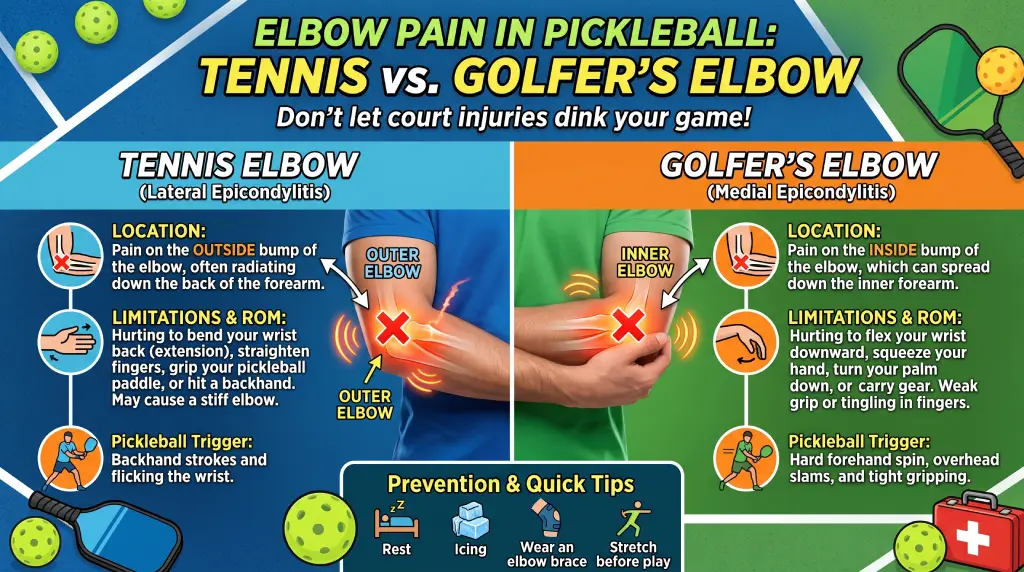
The difference comes down to one thing: where the pain sits. Pain on the bony bump on the outside of your elbow is tennis elbow (lateral epicondylitis). Pain on the inside bump is golfer’s elbow (medial epicondylitis). Both are overuse injuries of the forearm tendons, both punish your grip, and both get better with similar, but not identical, rehab.
- Tennis elbow hurts on the outer elbow and flares when you lift your wrist back or open a jar. Golfer’s elbow hurts on the inner elbow and flares when you curl your wrist or grip hard.
- Epicondylitis affects roughly 1% to 3% of the population each year, most often people aged 35 to 50, and tennis elbow is by far the more common of the two.
- Pickleball is a growing source of both. A 2026 Canadian survey estimates 1.8 million players, with Ontario leading at about 702,000.
- Most tennis elbow settles within 12 months of conservative care. A physiotherapy program with progressive loading usually gets there faster.
- Numbness or tingling into the ring and little fingers is not a tendon problem. Get that assessed.
The 30-second self-check
Make a fist and hold your arm straight out in front of you. Now bend your wrist backward, knuckles toward the ceiling. If that reproduces sharp pain on the outer elbow, tennis elbow is the likely culprit. It also tends to ache when you turn a doorknob, type, or lift a coffee mug.
Now flip it: palm up, resist someone gently pulling your wrist downward, or squeeze something hard. Pain on the inner elbow points to golfer’s elbow, formally medial epicondylitis. It flares with wrist curls, throwing, hammering, and long drives with a tight grip. A 2025 StatPearls review notes that medial epicondylitis makes up only about 10% of epicondylitis cases overall, so if you have elbow-side pain, the outside is statistically the more common site.
You can have both at once, and you can have neither. Bursitis, ligament sprains, pinched nerves in the neck, and ulnar nerve irritation at the elbow all mimic these conditions. A physiotherapist’s hands-on tests sort them out in one visit.
Why paddle sports keep filling clinic chairs
Tennis elbow was named for a racquet sport, but most of our patients never touch a tennis racquet. The injury follows any repetitive gripping and wrist loading: office work, yard work, new babies, and pickleball.
The pickleball numbers explain the trend. Pickleball Canada’s 2026 participation survey (published May 2026) estimates 1.80 million Canadians now play, up 14% in a year and 80% since 2022, with Ontario players making up the largest share at roughly 702,000. What happens to their elbows is well documented. In a 2025 study of 253 recreational pickleball players in the Journal of Functional Morphology and Kinesiology (Hanks & Myers), 41% reported at least one upper-extremity injury, and most of those were chronic overuse problems rather than acute falls. A companion 2025 study in the Journal of Hand Therapy (Myers et al.) screening pickleball players found positive test results for golfer’s elbow (7%) slightly more often than tennis elbow (5.4%). The takeaway for players: the inner elbow takes more load than most people expect, especially with a death grip on the paddle.
Tennis elbow vs golfer’s elbow: side by side
| Feature | Tennis elbow | Golfer’s elbow |
|---|---|---|
| Medical name | Lateral epicondylitis | Medial epicondylitis |
| Pain location | Outer elbow bump | Inner elbow bump |
| Tendon involved | Wrist and finger extensors (mainly ECRB) | Wrist and finger flexors and pronators |
| Wrist motion that reproduces pain | Extending the wrist back | Curling the wrist forward |
| Classic flare-ups | Lifting a mug, typing, opening jars | Gripping, hammering, golf swings, forehands |
| Share of epicondylitis cases | About 90% | About 10% (StatPearls, 2025) |
| Typical course | Most improve within 12 months of conservative care | Slower; roughly 80% recover within 1 to 3 years |
What actually helps: a 6-step plan
- Modify the load, don’t zero it out. Pause the aggravating activity for a couple of weeks. Full immobilization is not the goal. Tendons recover when you keep them gently working below the pain threshold.
- Ice after activity, heat before. Twenty minutes of ice calms a flared tendon. Warmth loosens tight forearm muscles before exercise. Our guide to heat or cold for pain relief covers the details.
- Brace at the right moment. A counterforce strap worn over the forearm muscle belly, just below the elbow, offloads the tendon during activity. Wear it for the tasks that flare you up, not around the clock.
- Start progressive tendon loading. For tennis elbow that means slow wrist-extensor work with a light dumbbell or a rubber resistance bar, three sets of fifteen, every other day, pain no worse than 3 out of 10. Golfer’s elbow uses the same principle with wrist flexion and pronation. Tendons respond to slow, heavy, regular loading, and this is where most people need a coach. Our physiotherapy program for tennis elbow builds this progression around your specific tendons.
- Address what’s upstream. Shoulder blade control, elbow flexor strength, grip size on your paddle or club, and your workstation setup all decide whether the tendon reloads tomorrow.
- Consider shockwave for stubborn cases. If six to twelve weeks of well-dosed exercise has not moved the needle, extracorporeal shockwave therapy is a reasonable next step for tennis elbow, with randomized trial evidence supporting pain and function gains. Details on our shockwave therapy for tennis elbow page.
Massage therapy and acupuncture, both offered at our clinics, can help with the muscle guarding that wraps around either injury while the tendon work does the heavy lifting.
When to see a physio in Pickering or Milton
Book an assessment if the pain has lasted more than two or three weeks, if grip weakness is affecting your work, or if you want to get back to golf or pickleball season without guessing. See us promptly if you notice numbness or tingling into the ring and little fingers, visible swelling or redness, or pain after a sudden pop or fall. Those patterns suggest nerve or structural involvement, and your plan changes.
Pro Fusion Rehab has physiotherapy clinics in Pickering and Milton serving clients across Durham, Halton, and the greater Ontario area. Book a Pickering or Milton appointment online or contact our team and we will tell you which elbow you have, and what to do about it this week.
Frequently asked questions
How long does tennis elbow take to heal compared to golfer’s elbow?
Tennis elbow usually improves within 6 to 12 weeks of structured loading and settles within about 12 months for most people. Golfer’s elbow tends to be slower, with roughly 80% recovering over one to three years without active rehab, which is why early loading work matters more on the inner side.
Can I keep playing pickleball or golf with either one?
Light play is usually fine if pain stays at 3 out of 10 or lower and settles back to baseline by the next morning. Tight grips, long sessions, and wristy strokes are the usual offenders. Shorten sessions, loosen the grip, and keep your loading exercises on schedule.
Is golfer’s elbow the same as a ulnar nerve problem?
No. Both live on the inner elbow, which causes confusion. Golfer’s elbow is sharp tendon pain with gripping or wrist curling. Ulnar nerve entrapment brings numbness, tingling, or weakness into the ring and little fingers, often worse at night. A physiotherapist can separate them with simple tests.
Do steroid injections help?
Cortisone shots can calm severe pain short term, but studies show high relapse rates and weaker outcomes at six to twelve months compared with exercise-based rehab. Many clinicians, including our team, reserve injections for cases that fail a solid trial of physiotherapy.
Will I need surgery?
Rarely. With proper conservative care, only a small percentage of tennis elbow cases eventually need a procedure, and golfer’s elbow less often still. Surgery is discussed after six to twelve months of well-executed non-operative treatment.