Book Appointment Now

Frozen Shoulder vs Rotator Cuff Tear: How to Tell the Difference
Can't lift your arm or can't move it at all? The passive motion test tells frozen shoulder from a rotator cuff tear in 60 seconds. What each means, and how Pickering and Milton physio treats it.
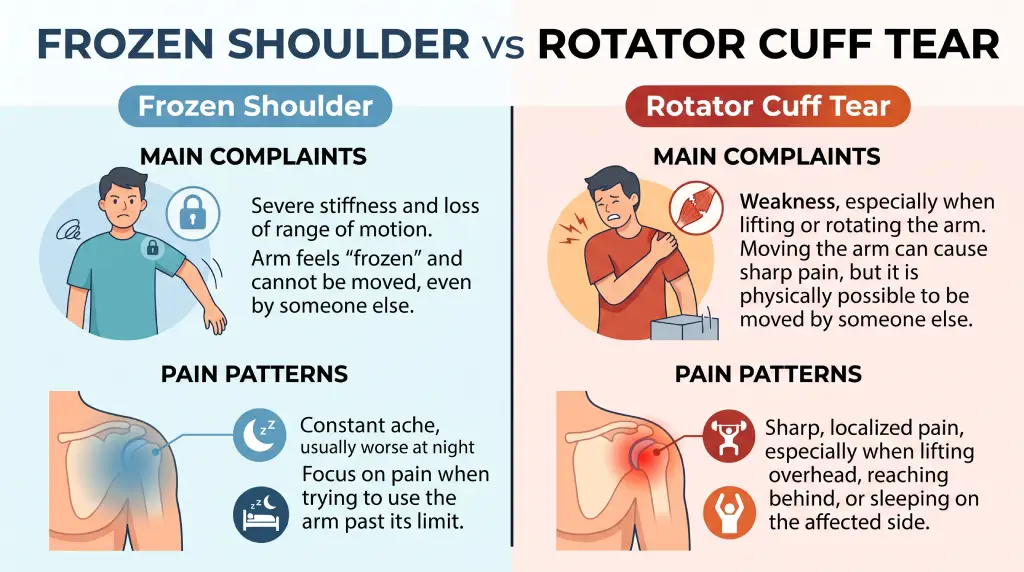
The fastest way to tell these two apart is the passive motion test. Have someone gently lift your relaxed arm. If it moves fairly freely but you can’t lift it yourself, that points to a rotator cuff problem, where weakness is the issue. If the arm stays stuck even when someone else moves it, that points to frozen shoulder, where the joint capsule has tightened. Stiffness versus weakness: that distinction changes what treatment should look like.
Key takeaways
- Frozen shoulder is a stiffness problem: active and passive movement are both limited.
- A rotator cuff tear is mostly a weakness problem: you struggle to lift the arm, but a helper can usually move it further.
- Both cause night pain, so sleep trouble alone doesn’t say which one you have.
- An ultrasound screening study found rotator cuff tears in 22.1% of adults, about two-thirds without symptoms.
- Frozen shoulder usually runs a 12 to 30 month course. Early physiotherapy shortens the painful stages.
- Get assessed if you can’t raise your arm overhead, pain wakes you at night, or stiffness keeps worsening.
Two different problems in the same joint
People often use “frozen shoulder” and “rotator cuff tear” interchangeably at our Pickering and Milton clinics. They are different injuries with different mechanics, and treating one like the other wastes months.
Frozen shoulder: the capsule contracts
Frozen shoulder (adhesive capsulitis) is inflammation and scarring of the joint capsule, the tissue sleeve around the shoulder. The capsule thickens and tightens, so the joint physically can’t move through its normal range. Your muscles may be fine; the capsule itself is the restriction. Primary frozen shoulder affects roughly 2% to 5.3% of the general population. People with diabetes or thyroid disease run much higher risk, with secondary rates between 4.3% and 38% (JOSPT Clinical Practice Guideline for Adhesive Capsulitis, 2013). It typically shows up between ages 40 and 65 and is more common in women (Adhesive Capsulitis, StatPearls, NCBI Bookshelf). Our older guide on frozen shoulder and physiotherapy intervention covers the stages in more detail.
Rotator cuff tear: the tendon gives out
The rotator cuff is a group of four tendons that lift and stabilize your arm. A tear means one has partially or fully pulled away from the bone, from a fall, a lift, or gradual wear. The capsule usually stays loose, which is why passive movement stays freer while active lifting is weak and painful.
Here’s the part that surprises most patients: tears are common and often harmless. In an ultrasound screening study of 664 adults (Yamaguchi et al., Journal of Shoulder and Elbow Surgery, 2006), 22.1% had a full-thickness rotator cuff tear, and about two-thirds had no symptoms. Prevalence climbed with age, from nothing under 50 to 36.6% over 80. An MRI showing a tear doesn’t automatically mean the tear is your problem, so treatment decisions rest on function, not the picture alone.
The 60-second self-check
Not a diagnosis, but it gives your physio a strong starting clue. You’ll need a helper and a few minutes.
- Sit relaxed and raise your sore arm out to the side as far as is comfortable. Note the height.
- Relax completely and let your helper gently lift the same arm through that arc. Don’t help with your muscles.
- Compare. If the helper gets noticeably higher than you did, weakness is limiting you, which fits a cuff problem.
- Reach for the small of your back with both hands. Frozen shoulder usually blocks this direction hard, with a sharp pinch at end range.
- Pin your elbow at your side at 90 degrees and rotate your hand outward like opening a jar. External rotation is the first movement frozen shoulder steals, so a flattened arc here is meaningful.
- Watch the pattern over weeks. Frozen shoulder creeps: rising stiffness, a constant ache, worse night pain. A cuff tear often starts with one movement that hurt, then settles into weakness on tasks like reaching overhead or lifting groceries.
If both arcs look similar and you still can’t tell, that’s a genuine gray zone. A painful tear you’ve guarded for months can stiffen the capsule, so both problems can be present at once. Get assessed rather than waiting it out.
Frozen shoulder vs rotator cuff tear at a glance
| Feature | Frozen shoulder | Rotator cuff tear |
|---|---|---|
| Main complaint | Stiffness, arm feels stuck | Weakness, arm drops or won’t lift |
| Active movement (yours) | Limited | Limited by pain or weakness |
| Passive movement (helper) | Also limited, firm end-feel | Usually better than active |
| Pain pattern | Constant ache, worse at night, worse as it progresses | Tied to specific movements, may ease at rest |
| Onset | Gradual, often no clear injury | Fall, lift, or insidious with age |
| Typical course | 12 to 30 months through three stages | Varies; small tears often settle with rehab |
| Key risk factors | Diabetes, thyroid disease, immobilization, age 40 to 65 | Overhead work, falls, age over 60 |
What treatment actually looks like
The self-check matters because the two conditions need opposite first moves. Frozen shoulder needs careful, persistent motion work before the capsule scars down further. A cuff tear needs load management and strengthening, and aggressive stretching of a torn tendon just irritates it.
Numbered plan of what we do at Pro Fusion:
- Confirm the pattern. A physiotherapist tests active and passive range, strength, and the classic special tests, then decides whether imaging adds anything. Many shoulder problems get treated without an MRI.
- Settle the pain. Manual therapy, soft-tissue massage around the shoulder blade and upper arm, and activity modification. In the freezing stage of frozen shoulder, gentle work comes before aggressive stretching.
- Restore motion in the right stage. For frozen shoulder: sustained stretching, pendulums, and mobility work progressed to your end-feel. For a cuff problem: motion within comfort while you protect the tendon.
- Rebuild strength. Scapular and cuff strengthening with progressive loading is the core of non-surgical cuff rehab.
- Fix the inputs. Posture, sleep positioning, and ergonomics at home and work. Acupuncture and dry needling can help some people break the night-pain cycle.
- Escalate thoughtfully. If a full-thickness tear leaves you functionally weak after months of solid rehab, refer for a surgical opinion. If frozen shoulder stalls, hydrodilatation or a guided injection can buy back motion.
How long does each take?
Frozen shoulder runs in three overlapping stages: freezing (2 to 9 months of rising pain and stiffness), frozen (3 to 12 months of peak stiffness with less pain), and thawing (up to 18 months as motion returns). The full cycle commonly takes 12 to 30 months, and diabetes tends to make it longer and tougher (Nagy et al., The Open Orthopaedics Journal, 2013). That’s why we treat early: the freezing stage is where physiotherapy most influences total duration.
A cuff strain or partial tear often improves in 6 to 12 weeks with structured physiotherapy. Full-thickness tears don’t heal on their own, but many become pain-free and functional with strengthening alone, consistent with the screening data above. Surgery is usually reserved for acute traumatic tears or tears that fail months of rehab.
When to see someone in Pickering or Milton
Book an assessment if any of these ring true: you can’t reach a shelf or fasten your seatbelt, the arm gives out when you lift, night pain wakes you reliably, or stiffness keeps getting worse. You don’t need imaging first, and you don’t need to stretch for a year before anyone will see you. Earlier evaluation is the difference between a 3-month plan and a 30-month one.
Our physiotherapy team in Pickering and Milton treats both conditions every week. You can book directly, no referral needed anywhere in Ontario. If you’re unsure which shoulder problem you’re dealing with, contact us and we’ll sort it out with you.
FAQ
Is a frozen shoulder the same as a rotator cuff tear?
No. Frozen shoulder is scarring of the joint capsule, which limits both your own movement and any movement someone else does for you. A cuff tear is damage to a lifting tendon: active movement is weak, passive movement usually stays freer. They can coexist when pain makes you guard a shoulder for months.
Can a physiotherapist tell without an MRI?
Often, yes. The active-versus-passive exam plus strength and range testing identifies the pattern in most cases. Imaging gets ordered when the exam is unclear, a full-thickness tear might need surgery, or symptoms don’t respond to treatment.
Does sleeping on my shoulder cause rotator cuff tears?
No. Positional night pain happens because an irritated shoulder hurts more when compressed or lying flat. Adjust your sleep position, but treat persistent night pain as a symptom to assess.
Is frozen shoulder more common in people with diabetes?
Yes, clearly. The JOSPT guideline reports secondary adhesive capsulitis rates of 4.3% to 38% in people with diabetes or thyroid disease versus 2% to 5.3% in the general population. It also tends to run longer and resist treatment more, which argues for early physiotherapy.
Which one is more serious?
Neither is automatically serious, but each has a red-flag version. A sudden weak, droopy arm after a fall can mean an acute complete tear that needs a prompt surgical opinion. Rapidly worsening stiffness with diabetes is the frozen-shoulder pattern where early treatment shortens the road. Both deserve assessment.