Book Appointment Now

Vertigo Relief
Vertigo Relief: Causes, Symptoms, and Evidence-Based Treatment

Vertigo is a distinct form of dizziness that creates a false sensation of spinning or movement. Rather than feeling lightheaded, you feel as though you or your surroundings are revolving. The balance system relies on complex coordination between the inner ear, eyes, and sensory nerves. When signals fall out of sync, sudden head motions can trigger severe disequilibrium, nausea, and disorientation.
At Pro Fusion Rehab, our experienced clinical team at our Milton clinic evaluates vestibular and cervical balance dysfunctions. Vestibular rehabilitation is provided at our Milton location, and patients in Pickering can be assessed at our Pickering clinic and referred. We combine registered physiotherapy, registered massage therapy (RMT), and acupuncture to help you regain your spatial balance and confidence.
At Pro Fusion Rehab, our experienced clinical team at our Milton clinic evaluates vestibular and cervical balance dysfunctions. Vestibular rehabilitation is provided at our Milton location, and patients in Pickering can be assessed at our Pickering clinic and referred. We combine registered physiotherapy, registered massage therapy (RMT), and acupuncture to help you regain your spatial balance and confidence.
Typical Symptoms & Common Causes of Vertigo
Vertigo episodes can last anywhere from a few seconds to hours or days. Furthermore, symptoms frequently worsen with rapid position shifts:
- Sensation of Spinning or Tilting: A persistent feeling of rotational movement when resting completely still.
- Loss of Balance and Unsteadiness: Difficulty walking straight, drifting toward one side, or feeling ungrounded.
- Motion-Induced Nausea: Queasiness, cold sweats, or vomiting provoked by turning your head or standing up.
- Nystagmus (Involuntary Eye Movements): Rhythmic, abnormal twitching of the eyes as the brain struggles to track balance signals.
- Associated Neck Stiffness: Rigid muscle tightness in the upper neck as you instinctively limit head movement.
Vertigo stems from disturbances within the peripheral vestibular apparatus or the cervical spine:
- Benign Paroxysmal Positional Vertigo (BPPV): The most frequent cause. Tiny calcium carbonate crystals (otoconia) break loose and drift into the fluid-filled semicircular canals of the inner ear.
- Cervicogenic Dizziness: Dysfunction, arthritis, or muscle hypertonicity in the upper cervical spine disrupts position signals sent from neck joints to the brain.
- Vestibular Neuritis and Labyrinthitis: Viral inflammation affecting the vestibular nerve or inner ear structures, causing continuous vertigo over several days.
- Ménière’s Disease: Fluid buildup within the inner ear chambers, typically accompanied by fluctuating hearing loss, ear fullness, and low-pitched tinnitus.
- Post-Concussion Syndrome: Trauma from sports impacts or car collisions that disrupts central vestibular processing in the brainstem.
Looking for Vertigo Relief?
Remaining completely immobile in a dark room can prolong recovery by preventing neural adaptation. Instead, practicing thoughtful daily precautions helps manage dizziness episodes safely:
- Rise Slowly from Positions: Sit on the edge of your bed for 30 seconds before standing up to let your balance system calibrate.
- Use Nightlights in Dark Hallways: Keep pathways lit at night. When vestibular signals are unreliable, your vision must compensate to prevent falls.
- Limit Sudden Head Movements: Turn your whole body rather than whipping your neck quickly when backing up a car or looking behind you.
- Stay Well Hydrated: Drink adequate water daily to maintain consistent blood pressure and fluid levels across inner ear structures.
- Seek an Early Clinical Assessment: BPPV and neck-related dizziness rarely resolve through rest alone. Therefore, obtain a proper vestibular evaluation promptly.
How Can Physiotherapy Treat Vertigo?
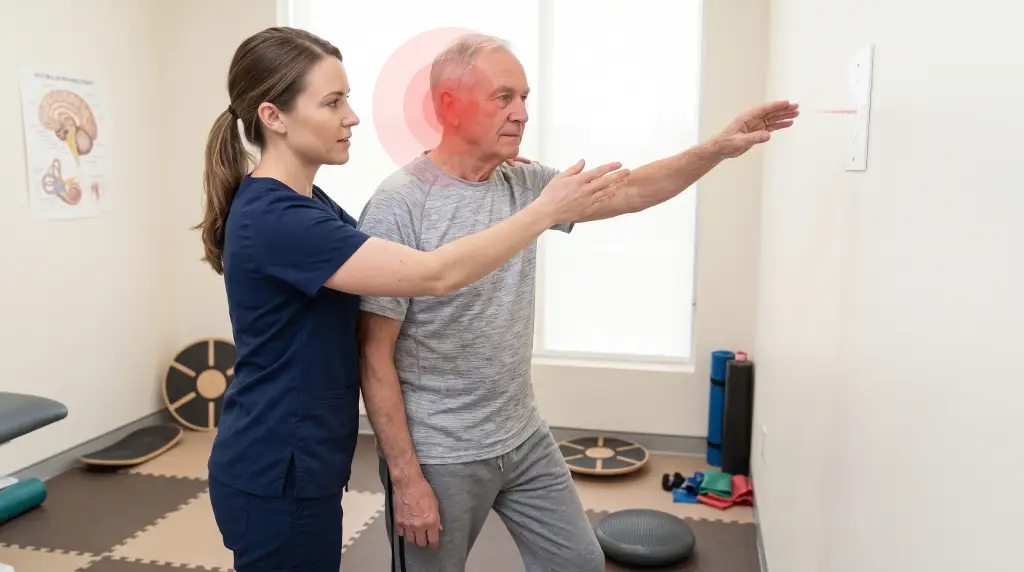
A Registered Physiotherapist evaluates your oculomotor tracking, cervical spine mobility, and positional vestibular triggers. Next, your therapist applies targeted interventions based on your diagnosis.
Key clinical approaches include:
Key clinical approaches include:
- 1. Canalith Repositioning Maneuvers: For BPPV, therapists use precise positional sequences, like the Epley or Semont maneuvers. These movements guide displaced crystals out of the semicircular canals back into the utricle.
- 2. Vestibular Rehabilitation Therapy (VRT): Tailored exercise protocols promote central neural compensation. As a result, the brain recalibrates balance signals and desensitizes to provocative motion.
- 3. Cervical Manual Therapy: Joint mobilizations to the upper cervical spine (C1–C3) restore normal arthrokinematics. Consequently, false proprioceptive signals traveling from tight neck muscles to the brainstem decrease.
- 4. Gaze Stabilization Drills: Eye-head coordination exercises retrain the vestibulo-ocular reflex (VOR). This allows your vision to remain clear and steady while your head is in motion.
Vertigo Treatment at Pro Fusion Rehab (Milton Clinic)
At Pro Fusion Rehab, our multidisciplinary team coordinates care to deliver efficient recovery:
- Registered Physiotherapy: We provide positional canalith maneuvers, cervical joint mobilizations, and vestibular retraining programs.
- Registered Massage Therapy (RMT): Our therapists relieve deep muscle tightness across the suboccipitals, upper trapezius, and sternocleidomastoid.
- Acupuncture: We use neuro-functional acupuncture to downregulate nervous system tension, ease motion nausea, and improve local blood flow.
- Balance and Fall Prevention Training: We offer functional movement evaluations to help restore personal confidence during everyday walking.
Frequently Asked Questions (FAQs)
How quickly can BPPV be treated with repositioning maneuvers?
Most straightforward cases of BPPV resolve within 1 to 3 treatments using appropriate repositioning maneuvers like the Epley. Once loose crystals return to their proper chamber, spinning sensations typically cease immediately.
How can I tell if my dizziness is coming from my neck or my inner ear?
Inner ear vertigo usually causes an intense spinning sensation triggered by tipping your head back or rolling in bed. Cervicogenic dizziness feels more like a general unsteadiness or floating sensation, accompanied by neck pain, limited range of motion, or headaches. A clinical assessment pinpoints the exact driver.
Can stress or anxiety trigger a vertigo episode?
Yes. Chronic stress elevates cortisol levels and tightens upper cervical musculature, which can alter normal sensory integration. Additionally, anxiety heightens brain sensitivity to normal balance fluctuations, making minor dizziness feel magnified.
What red-flag symptoms require emergency medical care?
Seek emergency medical evaluation immediately if vertigo is accompanied by sudden double vision, slurred speech, facial drooping, numbness or weakness in your limbs, difficulty swallowing, or a sudden, severe headache unlike anything experienced before.

Home Exercises and Remedies for Vertigo Relief
Gentle home exercises encourage brain adaptation and steady visual tracking between appointments. Perform these movements seated comfortably in a safe environment:
- Brandt-Daroff Habituation Exercise: Sit on the edge of your bed. Lie down quickly onto your left side with your nose pointed at a 45-degree angle upward. Stay for 30 seconds, sit upright for 30 seconds, and repeat on the right side. Complete 5 repetitions to help clear canal debris.
- Gaze Stability Focus (VOR x1): Hold your thumb at arm’s length in front of your eyes. Focus your vision on your thumbnail while slowly turning your head side to side for 30 seconds. Keep the target in sharp focus throughout the movement.
- Seated Head Nods: Sit tall in a firm chair with eyes open. Slowly look up toward the ceiling, then down toward the floor, keeping your gaze relaxed. Repeat for 10 smooth, unhurried repetitions to desensitize vertical motion.
- Suboccipital Neck Release: Place a rolled towel under the base of your skull while lying on your back for 10 minutes. This releases hypertonic suboccipital muscles that frequently aggravate cervicogenic dizziness.
- Paced Walking in a Open Space: Walk forward along a clear hallway while slowly turning your head left and right with every two steps. Practice for 1 to 2 minutes to challenge and rebuild dynamic balance.
Find The Physiotherapy Clinic Near You
Pro Fusion Rehab has 2 well designed and modern rehabilitation clinics, located at Pickering and Milton Ontario.
Pickering Physiotherapy Clinic
Milton Physiotherapy Clinic
Try Our Direct Billing Service
Lower Your Upfront Payment
We direct bill most of the Group Health Benefits, WSIB and Auto Insurance Company