Book Appointment Now

Plantar Fasciitis vs Achilles Tendinopathy: What’s the Difference, and How Do You Fix It?
Not sure if it's plantar fasciitis or Achilles tendinopathy? Learn the difference by pain location, what treats both, and when to see a physio in Pickering or Milton.
If your heel hurts, where it hurts usually tells you what’s wrong. Plantar fasciitis hurts on the bottom of the heel, sharpest with the first steps in the morning. Achilles tendinopathy hurts on the back of the heel or up the tendon, stiffest when you start moving and sore when you pinch it between your fingers. Both are overuse injuries of connective tissue, both respond to load-based physiotherapy, and neither one heals reliably from rest alone.
That last point surprises most people. About 1 in 10 people deal with plantar fasciitis at some point, most often between ages 25 and 65 (StatPearls, NIH). Achilles tendinopathy turned up in 4.2% of recreational runners over a single 20-week training period in a large Dutch cohort study (Journal of Sport and Health Science, 2023). These are common, well-understood problems, and the treatment evidence has moved well past “ice it and wait.”
Key takeaways
- Pain on the bottom of the heel points to plantar fasciitis; pain on the back of the heel or above it points to Achilles tendinopathy. You can have both at once.
- Most people never need surgery. Roughly 70–80% of plantar fasciitis cases improve within 9 to 12 months of conservative care (StatPearls, NIH).
- Progressive loading exercise is the core treatment for both. Complete rest weakens the tissue and usually prolongs the problem.
- A previous episode is the strongest predictor of a repeat: runners with Achilles symptoms in the past year were about six times likelier to develop them again.
- A physiotherapist can confirm which structure is irritated, check your calf and ankle mechanics, and build a loading program that fits your life.
The difference is anatomy: where does it hurt?
The plantar fascia is a thick band of tissue running from your heel bone to the base of your toes. It supports the arch and absorbs load every time your foot hits the ground. When the tissue at its heel attachment gets overloaded, it becomes painful and degenerated. That’s plantar fasciitis.
The Achilles tendon is different tissue doing a different job. It connects your calf muscles to your heel bone and handles the push-off and spring in every step, run, and jump. Tendinopathy means the tendon has become painful and less able to tolerate load, usually after a training spike or a sudden change in activity.
The practical test is simple: press on the spot that hurts. Pain on the bottom of the heel, especially near the inner bony bump, is the classic plantar fascia pattern. Pain 2–6 cm above the heel bone, or right at its back edge where shoes rub, is the classic Achilles pattern.
Symptom comparison at a glance
| Feature | Plantar fasciitis | Achilles tendinopathy |
|---|---|---|
| Pain location | Bottom of heel, often inner side | Back of heel, or 2–6 cm above it |
| Morning symptoms | Sharp with first steps, eases after a few minutes | Stiff at rest, eases as you warm up |
| With activity | Often improves mid-activity, aches after | Worse with running, jumping, hills, stairs |
| On exam | Tender pressing the heel’s bottom edge | Thickening or tenderness pinching the tendon |
| Common in | Middle-aged adults, standing workers, new walkers | Runners, court-sport players, anyone spiking load |
One honest caveat: some people carry both problems at once, because they share an upstream issue, a calf that can’t handle the load being put through it. Tight or weak calf muscles pull on the heel from above and stress the plantar fascia from below. That’s why a good clinician looks at the whole ankle-foot unit, not just the sore spot.
Why these injuries happen
Both conditions are load problems. The tissue is exposed to more than it can currently tolerate, and its response shifts from healthy remodeling to pain and degeneration.
For plantar fasciitis, the well-documented risk factors are increased body weight, limited ankle dorsiflexion (a stiff ankle joint), prolonged standing on hard surfaces, and sudden jumps in activity (StatPearls, NIH). It’s common in people returning to exercise after a sedentary stretch, in teachers and nurses on their feet all day, and in runners who add mileage too fast.
For Achilles tendinopathy, the strongest known predictor is a previous episode. In that Dutch runner cohort, symptoms in the past 12 months raised the odds roughly six-fold (Journal of Sport and Health Science, 2023). The other consistent triggers are training spikes, hills or speed work introduced too quickly, and unsupportive footwear worn long after its cushioning is gone.
How physiotherapy treats both conditions
Despite the different anatomy, the treatment logic is nearly identical.
1. Calm the tissue down without resting it to death. Relative load management, meaning temporary adjustments to what aggravates it, buys comfort while the real work starts. Complete rest is the wrong goal. Unloaded tendon tissue loses capacity fast.
2. Progressive loading. This is the centerpiece for both. For the Achilles, it means staged calf raises: isometric holds first for pain relief, then slow heavy resistance, then energy-storing work like hopping once you’re ready. For the plantar fascia, high-load strength work for the foot and calf has good evidence, sometimes paired with taping or a foot brace to protect the arch while it settles.
3. Restore ankle and foot mechanics. Manual therapy, calf and soleus mobility work, and targeted treatment for a stiff ankle joint address the upstream contributors so results stick.
4. Fix the whole load picture. Shoes, workstation, training schedule, body weight. Small changes across several of these add up. For stubborn cases, adjuncts like shockwave therapy are a reasonable conversation once proper loading has stalled for a few months.
Set your timeline expectations early. Most plantar fasciitis improves within 9–12 months of conservative care, and tendon programs show real change around the 12-week mark if the loading is progressive and consistent (StatPearls, NIH). A program you can keep doing beats an aggressive one you quit.
How Shockwave Therapy Helps Plantar Fasciitis
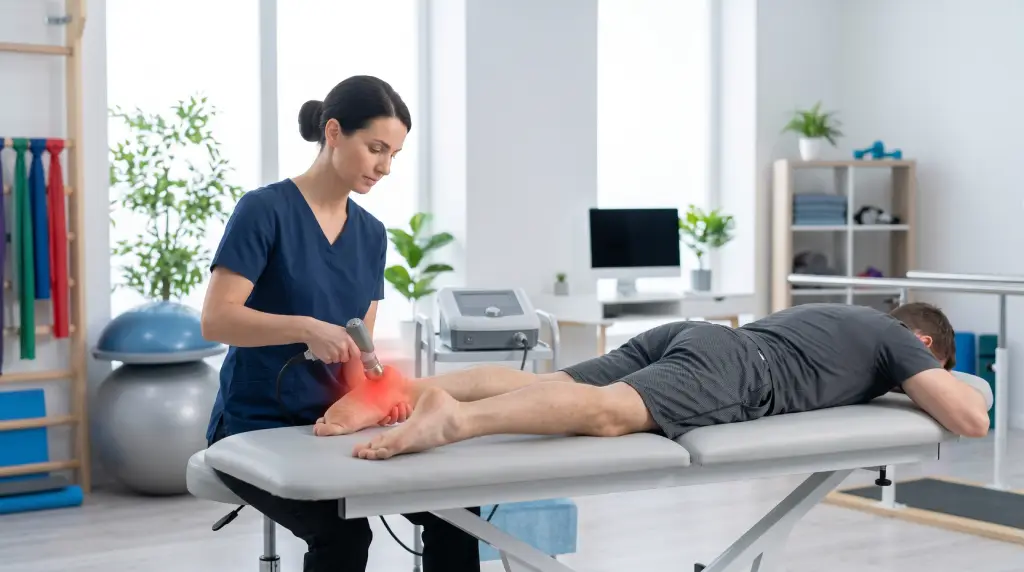
If your heel pain hasn’t improved after a few months of standard calf raises and load management, extracorporeal shockwave therapy (ESWT) is one of the most effective non-invasive treatments available:
- Jump-starts natural healing: Shockwave therapy sends gentle acoustic sound waves directly into the thick connective band at the bottom of your foot. This stimulates local blood flow, releases natural growth factors, and helps restart the repair process in stubborn, chronically irritated tissue.
- Quick, non-surgical relief: Most treatment plans require only 3 to 5 quick sessions (spaced about a week apart) with zero downtime, making it a proven alternative to cortisone injections or surgery.
- Pairs with exercise for lasting results: Shockwave therapy is not a standalone cure—its real strength is rapidly knocking down pain so you can walk comfortably and complete the strengthening exercises needed to keep the pain from coming back.
- Local physiotherapy care: If you are dealing with persistent arch or heel pain in the Pickering, Milton, or Greater Toronto Area, our registered physiotherapists incorporate shockwave therapy alongside customized foot loading programs to get you back on your feet pain-free.
When to see a physiotherapist in Pickering or Milton, Ontario
Self-management is reasonable for the first couple of weeks. Get assessed sooner if:
- Pain has lasted more than 2–3 weeks or is getting worse
- Morning heel pain now affects every step of the day
- You felt a sudden pop at the back of the heel, or you can’t push off or rise on your toes. That needs prompt assessment to rule out an Achilles rupture
- You’ve had it before and it keeps coming back
At Pro Fusion Rehab, our physiotherapy clinics in Pickering and Milton, Ontario assess heel pain as a whole-leg problem: ankle motion, calf strength, foot arch mechanics, and your actual weekly load. If you’re not sure which condition you’re dealing with, a single assessment usually settles it, and you leave with exercises matched to the diagnosis. You can book an appointment online.
Frequently asked questions
Can you have plantar fasciitis and Achilles tendinopathy at the same time?
Yes. They share risk factors (stiff ankles, weak or tight calves, load spikes), and each raises stress on the other structure. Treating one while ignoring calf capacity is a common reason symptoms come back.
Does heel pain always mean plantar fasciitis?
No. Other causes include fat pad bruising, stress fractures of the heel bone, nerve entrapment, and, in kids, growth-related heel pain called Sever’s disease. A proper assessment matters before you commit to a diagnosis, especially after an injury or if you have night pain.
How long does Achilles tendinopathy take to heal with physiotherapy?
With a consistent progressive loading program, most people feel clear change in about 12 weeks; heavier training goals can take 3–6 months. The strongest predictor of a slow recovery isn’t severity. It’s stopping the program early or loading it inconsistently.
Are orthotics, night splints, or injections necessary?
Usually not as first-line care. Night splints and supportive footwear can ease symptoms while you build capacity. Injections, including corticosteroids near the Achilles, carry trade-offs and don’t fix the underlying load intolerance. Strength work is the treatment the evidence backs most strongly.
Will running make it worse?
Not necessarily. For many people, modified running is part of recovery. The goal is keeping symptoms manageable during and after runs, then rebuilding tolerance gradually. Blanket running bans often just decondition the tendon before you restart.
Heel pain is common, treatable, and rarely a surgery story. Work out which tissue is unhappy, load it progressively, fix what’s upstream, and give the program 12 honest weeks. If you’re in Pickering, Milton, or the surrounding Durham and Halton areas, a physiotherapy assessment at Pro Fusion Rehab is the fastest way to get started.