Book Appointment Now

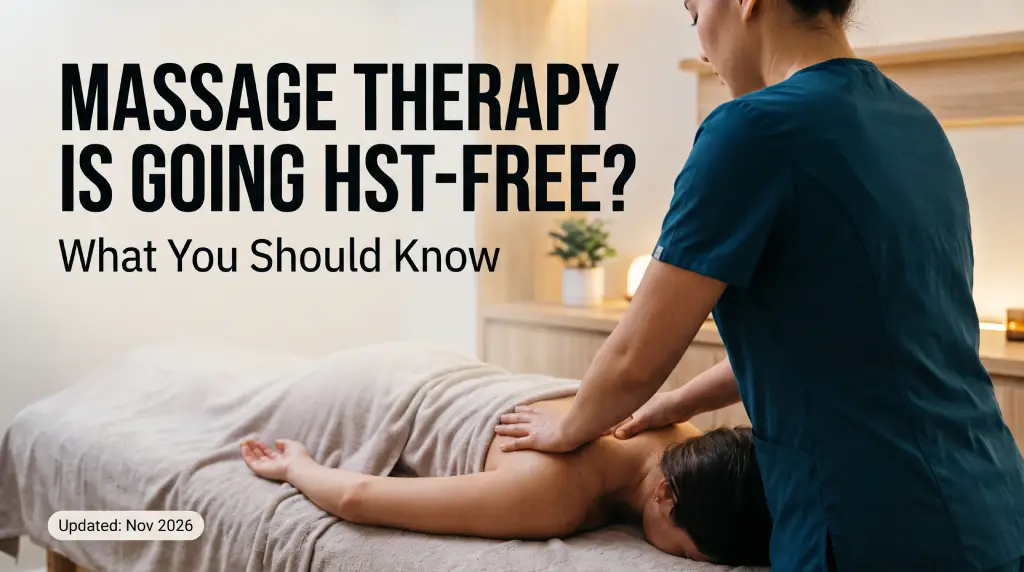
Massage Therapy Is Going HST-Free, But Not Yet: What Patients Should Know
Budget 2026 announced a GST/HST exemption for massage therapy, but it is a proposal, not law. What that means for patients in Pickering, Milton and Ontario, and how the 2014 acupuncture exemption played out.
Key takeaways
- The federal government announced a proposed GST/HST exemption for massage therapy on November 5, 2026.
- It is a proposal, not law. In Ontario, the 13% HST still applies to treatment by a Registered Massage Therapist.
- The proposal covers healthcare massage therapy delivered by a Registered Massage Therapist, not spa or relaxation massage.
- A bill must pass Parliament and receive Royal Assent before the rule changes.
- The Canadian Massage Therapist Association and the RMTAO both tell therapists to keep charging until the change is official.
- This is general information, not tax advice.
The massage therapy HST exemption is a proposed measure, and it is not yet law. The federal government announced it on November 5, 2026, but in Ontario the 13% HST still applies to healthcare massage therapy delivered by a Registered Massage Therapist. Headlines saying the tax has already disappeared are inaccurate. A budget announcement states an intention. It becomes binding only when Parliament passes an amendment to the Excise Tax Act and that amendment receives Royal Assent. Until then, therapists continue to collect the tax and patients continue to pay it. This is general information, not tax advice.
What Is The Status Of The Massage Therapy HST Exemption?
On November 5, 2026, the Department of Finance Canada released the Budget 2026: Tax Measures, Supplementary Information, 2026. It states that the government proposes to add qualifying massage therapists to the list of health care practitioners whose professional services are exempt from the GST/HST. It adds that the measure would apply to qualifying supplies of massage therapy services made after Budget Day.
A Notice of Ways and Means Motion to amend the Excise Tax Act, 2026 was tabled the same day. It adds massage therapy services to section 7 of Part II of Schedule V to the Excise Tax Act. These documents describe the plan. They are not statutes. They are the opening steps of a process that ends with Royal Assent.
HST Or GST/HST: Which Term Applies In Ontario?
Both labels describe the same tax from different angles.
The federal measure is drafted as a GST/HST amendment, because the GST applies in every province and the HST is the harmonized version used in participating provinces. Ontario uses the HST, set at 13%, which combines the 5% federal part with an 8% Ontario part. So a federal release will say GST/HST, while a receipt or a price list in Pickering or Milton will show 13% HST. When this article says HST, it is describing the Ontario rate. When it quotes Finance Canada, the wording is GST/HST.
Which Treatments Does The Proposal Actually Cover?
The exemption is aimed at healthcare massage therapy delivered by a Registered Massage Therapist, not at every massage serviced in Ontario.
The budget text sets two conditions. The person must practise the profession of massage therapy, and must be licensed or certified where the service is supplied, or hold equivalent qualifications where the province does not license the profession. Ontario RMTs satisfy the first route: they are registered with the College of Massage Therapists of Ontario.
The Canadian Massage Therapist Association campaign material, 2026 puts the boundary plainly. The profession asked for the exemption for regulated therapeutic massage therapy, not spa services. A relaxation massage from an unregistered practitioner sits outside the measure as drafted, so the tax treatment there is a separate question.
Why Is The Exemption Not Yet Law?
In Canada, a budget is a policy document. It sets direction, but it does not change legislation on its own. A bill has to be drafted, introduced, debated, and voted on. Only after it passes both chambers and receives Royal Assent does it become law.
That distinction is not academic. Proposed tax measures can change or vanish. The Prime Minister of Canada news release, March 21, 2025 cancelled a capital gains increase that had been announced in 2024 with an effective date, and it never took effect. Announced is not the same as enacted.
What Do The Massage Therapy Associations Say?
The professional bodies have been consistent, and their advice matches the legislation.
The Canadian Massage Therapist Association, which speaks nationally, states in its 2026 campaign material that massage therapists must continue to charge GST/HST until the change is official. Its November 5, 2026 announcement welcomed the measure and said the association will work with government on implementation and a smooth transition. It did not tell therapists to stop charging.
The Registered Massage Therapists’ Association of Ontario reaches the same conclusion. Its HST Guideline for Ontario, 2017 sets out that RMTs levy, collect, and remit HST until the profession meets the exemption criteria, and the association has continued to press the case federally. Both bodies, in other words, recommend collecting as usual until the matter is settled.
How Do These Processes Usually Play Out?
Timelines vary, and a measure can apply retroactively to budget day even when the law arrives months later.
| Measure | Announced Effective Date | When It Became Law | Wait Period |
|---|---|---|---|
| 2014 Acupuncture and Naturopathy Exemption | February 11, 2014 | June 19, 2014 | About 4 months |
| Budget 2025 Implementation Act (Bill C-15, 2026) | November 4, 2025 | March 26, 2026 | About 4.5 months |
| Budget 2025 Second Implementation Act (Bill C-31, 2026) | May 6, 2026 | Still before Parliament in fall 2026 | Over 5 months |
| 2024 Capital Gains Proposal | June 25, 2024 | Never enacted | Cancelled |
Looking Back: What Happened With The 2014 Acupuncture Tax Exemption?
The acupuncture case shows what “effective on budget day” looks like in practice.
The 2014 budget was tabled on February 11, 2014. Sections 52 and 53 of the Economic Action Plan 2014 Act, No. 1, 2014 amended the same list of exempt practitioners to add acupuncture services and naturopathic services. Both sections say the amendment applies to any supply made after February 11, 2014, wording that matches the 2026 notice of ways and means motion for massage therapy.
Royal Assent came on June 19, 2014, about four months later, and the exemption still reached back to budget day. Because tax had been collected in between, section 232 of the Excise Tax Act allowed the excess to be refunded or credited within two years, with a credit note issued. The phrase is a promise about the start date, not about the start of the law.
Practical Steps For Your Next Appointment
While the process unfolds, patients in Pickering, Milton, and across Ontario can follow five steps.
- Pay as you normally would. The 13% HST still applies to RMT treatment.
- Ask for an itemized receipt every visit, and keep it.
- Check your extended health limits, since tax changes do not alter plan rules.
- Watch for a budget implementation bill in Parliament.
- Ask an accountant about credits or refunds rather than assuming one is automatic.
For background on treatment itself, see our massage therapy page. The team at Pro Fusion Rehab works at both clinics and can help with receipts or documentation at our direct phone numbers. Reach the front desk through our clinics in Pickering and Milton.
FAQ
Is Massage Therapy Tax Free Right Now?
No. In Ontario, the 13% HST still applies to healthcare massage therapy by a Registered Massage Therapist. The exemption exists only as a proposal in Budget 2026. It reaches patients only when Parliament passes the amending legislation and it receives Royal Assent. Until then, therapists collect the tax.
Which Treatments Are In Scope?
Healthcare massage therapy delivered by a Registered Massage Therapist. Ontario RMTs are registered with the College of Massage Therapists of Ontario, which is the licensing condition the budget text describes. Spa and relaxation massage from an unregistered practitioner fall outside the measure as drafted.
Why Does The Article Say HST In Some Places And GST/HST In Others?
Because the two labels belong to different levels. The federal amendment is written as a GST/HST change, since the GST applies nationwide. Ontario’s harmonized tax is 13%, made of the 5% federal part and an 8% provincial part. On an Ontario receipt it appears as HST.
What Does Supplies Made After Budget Day Mean?
It is the start date the government intends. If the final law keeps that wording, treatment paid for on or after November 5, 2026 would be exempt once the law exists. It does not make the tax disappear today, and it does not apply until a bill passes.
What Happens To HST Already Paid If The Bill Passes?
Section 232 of the Excise Tax Act allows a practitioner who collected tax in excess of what was collectible to adjust the charge, or refund or credit the amount, within two years, issuing a credit note. It is an administrative step, not an automatic payment. Ask an accountant about your own situation.
Does Insurance Coverage Change With This Announcement?
No. Coverage is a private agreement between you and your insurer, separate from tax law. Your annual maximum, co-payment, and eligibility rules stay as they are, and you keep submitting receipts the way you always have.