Book Appointment Now

Shin Splints Vs Stress Fracture: How To Tell The Difference
Pinpoint shin pain or a broad ache? Learn how to tell shin splints from a stress fracture, when an X-ray misses it, and safe return-to-run steps.
Shin Splints Vs Stress Fracture: How To Tell The Difference
Key takeaways
- Medial tibial stress syndrome causes broad aching along the inner shin, while a stress fracture produces pinpoint bone pain under 5 cm.
- Stress fracture pain persists throughout exercise and forces runners to stop, whereas stress reactions often warm up early.
- Standard radiographs have only 10% sensitivity during the first 2 to 3 weeks and cannot rule out a stress fracture.
- Most stress fractures heal within 8 weeks using conservative treatment and guided relative rest.
- Medial tibial stress syndrome can take up to 12 months to resolve completely without structured load management.
- An early clinical physiotherapy assessment in Pickering or Milton protects bone health and shortens recovery.
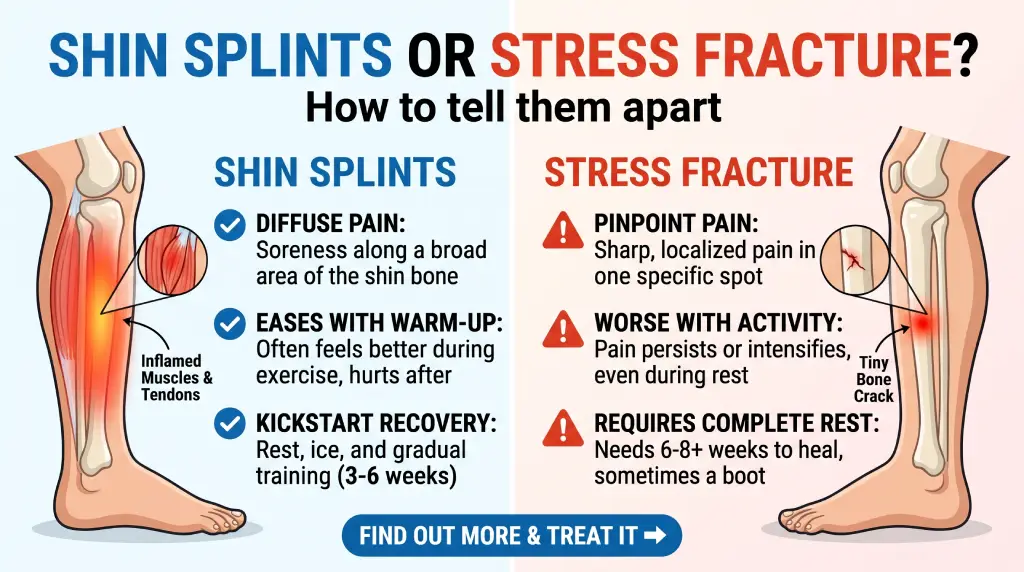
Shin splints cause diffuse tenderness along the lower leg bone, whereas a stress fracture produces pinpoint bone pain that sharpens under load. If your shin aches across a broad area and warms up early in a workout, you likely have a bone stress reaction that improves with modified training. If your shin throbs in one localized spot under 5 cm and aches during walking, you may have a stress fracture that requires imaging and temporary rest. Early identification prevents a manageable reaction from turning into a full cortical break.
What Is The Difference Between Shin Splints And A Stress Fracture?
According to Fallon K. (2023) in the Australian Journal of General Practice, the term “shin splints” is essentially meaningless and should no longer be used. The label historically covered medial tibial stress syndrome (MTSS), bone stress reactions, stress fractures, and chronic exertional compartment syndrome.
When training volume spikes abruptly, bone resorption outpaces repair. Continued pounding without adequate recovery drives microdamage toward a structural crack. Kahanov L. and Eberman L.E. (2015) report that stress fractures account for between 1% and 20% of athletic injuries, with 80% of stress fractures in the lower extremity. The same authors confirm that the tibia is the most common site of stress reactions and stress fractures in runners.
How Can You Tell Which Injury You Have?
Fallon K. (2023) notes that on palpation, a shorter, more focal area of tenderness (less than 5 cm) is more indicative of a stress fracture.
A stress reaction also behaves differently under load. In a medial tibial stress reaction, pain typically comes on at the start of activity and is relieved quickly by rest. In a stress fracture, the pain is more constant during exercise and usually forces the athlete to stop (Fallon K., 2023).
| Clinical Feature | Shin Splints (Medial Tibial Stress Syndrome) | Tibial Stress Fracture |
|---|---|---|
| Tenderness Area | Diffuse line along inner tibia (often > 5 cm) | Focal pinpoint spot (less than 5 cm) |
| Pain Behavior | Often warms up early in run, aches afterward | Constant or worsening pain during run, forces stopping |
| Daily Walking Pain | Rare during ordinary slow walking | Common with every step or hopping |
| Night Pain | Minimal or absent | Frequent throbbing ache at rest or at night |
| Typical Recovery | Can take up to 12 months to heal fully | Most heal within 8 weeks with conservative care |
What Is The At-Home Decision Test For Shin Pain?
A single-leg hop test provides a practical at-home screen. First, hop once on your uninjured leg to test comfort. Next, stand on your painful leg and hop gently. Stop immediately if you feel sharp bone pain.
Athletes with mild stress reactions usually tolerate a hop with mild, diffuse aching. In contrast, runners with a stress fracture experience sharp, localized jarring pain that makes hopping intolerable. If hopping provokes severe focal pain, stop running and book an evaluation.
What Are The Red Flags That Mean You Must Stop And Get Assessed?
Certain warning signs indicate severe structural bone damage or nerve issues. Stop running and seek an evaluation if you experience:
- Inability to bear weight without limping
- Severe pinpoint tenderness on the front shin ridge
- Persistent night pain waking you from sleep
- Visible swelling, redness, or a distinct bump along the tibia
- Numbness, tingling, or coldness in your foot
Bone location strongly influences risk. Kahanov L. and Eberman L.E. (2015) identify anterior tibial stress fractures as high risk, with an estimated return time of 6 to 8 weeks. The anterior tibia endures heavy tension during running, requiring clinical oversight to prevent nonunion fractures.
How Long Does Recovery Take For Each Condition?
Recovery timelines depend on whether your injury is an inflammatory stress reaction or a structural fracture.
Medial tibial stress syndrome requires patience. Fallon K. (2023) notes that MTSS can take up to 12 months to heal. The incidence of medial tibial stress syndrome is 4% to 17% across athletic populations (Fallon K., 2023). Bone stress injuries resolve through predictable biological stages. Kahanov L. and Eberman L.E. (2015) state that the vast majority of stress fractures heal within 8 weeks through conservative treatment. According to Kahanov L. and Eberman L.E. (2015), estimated return times include:
- Low-risk minor injury: less than 3 weeks
- Anterior tibia (high risk): 6 to 8 weeks
- Posteromedial tibia, low risk with a cortical break: 8 to 12 weeks
In the Journal of Orthopaedic & Sports Physical Therapy, Warden S.J., Edwards W.B. and Willy R.W. (2021) report that low-risk bone stress injuries of the tibia and metatarsal diaphyses account for more than half of bone stress injuries in runners. Their research emphasizes that optimal load is symptom driven, meaning it does not produce symptoms during, after, or the day following loading.
What Does A Safe Return-to-Running Progression Look Like?
Complete each stage pain-free during and the day following before advancing:
- Walk briskly for thirty minutes on level ground with zero bone ache.
- Complete run-walk intervals: one minute of easy jogging alternated with two minutes of walking for twenty minutes.
- Advance to two minutes of running and one minute of walking once short intervals feel comfortable.
- Progress to twenty minutes of continuous jogging at an easy pace.
- Increase your weekly distance by no more than ten percent per week.
If pain returns, step back to the previous symptom-free stage.
When Should You Get An X-Ray Or MRI?
Early plain radiographs frequently miss acute bone injuries.
Kahanov L. and Eberman L.E. (2015) state that radiographs have poor sensitivity (10%) within the first 2 to 3 weeks, so a normal X-ray does not rule out a stress fracture. An MRI represents the diagnostic gold standard, detecting deep bone marrow edema before a visible crack forms.
A physiotherapist evaluates your physical symptoms to determine if imaging is warranted or if conservative care can proceed safely.
What Does A Physiotherapy Assessment Add To Your Recovery?
Treating shin pain requires more than passive rest on the couch.
At Pro Fusion Rehab, our clinicians evaluate ankle mobility, foot mechanics, hip stability, and calf strength. Weak calf muscles force the tibia to absorb excessive impact vibrations during footstrike. Our clinic integrates shockwave therapy, acupuncture, and progressive strengthening to rebuild load capacity. Reviewing our clinical guides on sports injuries or ankle strain clarifies how lower limb mechanics interact.
In Pickering and Milton, Ontario road conditions shift in late fall. Cold weather hardens paved routes across Durham and Halton region, increasing shock transmission. Adjusting shoe cushioning, cadence, and running terrain protects healing bone.
Our registered physiotherapists at Pro Fusion offer detailed physical evaluations across both clinics. You can easily schedule an appointment for physiotherapy in Pickering and Milton to confirm your diagnosis. If you need guidance regarding your shin pain, please contact us directly to consult our clinical team today.
FAQ
Does An X-Ray Rule Out A Stress Fracture In The First Two Weeks?
No. Plain radiographs have a sensitivity of only 10% during the first 2 to 3 weeks, according to Kahanov L. and Eberman L.E. (2015). A normal X-ray cannot rule out an early stress fracture. An MRI is far more reliable for detecting early bone stress.
Can You Walk Through Shin Splints Without Making Them Worse?
Yes, if walking remains completely pain-free. Warden S.J., Edwards W.B. and Willy R.W. (2021) note that optimal load is symptom driven, causing no symptoms during, after, or the following day. If walking provokes bone pain, reduce daily steps.
When Is Shin Pain Considered An Urgent Concern?
Shin pain accompanied by foot numbness, cold toes, or severe compartment tightness requires urgent medical attention. A sudden sharp pop followed by an inability to bear weight also warrants an immediate medical evaluation.
Can Running On Hard Ontario Sidewalks Worsen Tibial Bone Stress?
Yes. Cold autumn temperatures harden pavement, increasing tibial impact shock during late fall training in Ontario. Rapid surface transitions frequently overwhelm bone remodeling capacity if mileage is not adjusted appropriately.
What Is The Main Difference In Tenderness Between Shin Splints And A Stress Fracture?
Medial tibial stress syndrome causes broad tenderness along a section of bone exceeding 5 cm. A stress fracture produces pinpoint tenderness concentrated across a focal area of less than 5 cm, as documented by Fallon K. (2023).