Book Appointment Now


Shockwave Therapy For Tennis Elbow
Shockwave therapy for tennis elbow: how it works, what the evidence shows, and what to expect. Non-invasive physiotherapy treatment in Pickering and Milton, Ontario.
If your tennis elbow hasn’t settled with rest, stretches, or braces, shockwave therapy is a non-invasive treatment option worth asking about. It uses acoustic pressure waves to stimulate blood flow in the damaged tendon, and clinical studies back it for reducing pain and improving grip strength. At our physiotherapy clinics in Pickering and Milton, Ontario, physiotherapists combine shockwave therapy with hands-on treatment and targeted exercise to get you back to lifting, gripping, and training without elbow pain.
Key Takeaways
- Tennis elbow (lateral epicondylitis) affects 1% to 3% of adults each year, mostly between ages 35 and 50. Despite the name, only 5% to 10% of cases come from racket sports.
- A 2020 meta-analysis found shockwave therapy significantly reduced pain and improved grip strength in tennis elbow, with better overall safety than corticosteroid injection.
- Most patients notice pain relief within the first few sessions. A typical course is a series of sessions spaced about a week apart, combined with physiotherapy exercises.
- Treatment works best when 6 to 12 weeks of conservative care hasn’t resolved your symptoms. A physiotherapist can confirm whether your elbow pain is actually tennis elbow before you book a course.
What is tennis elbow?
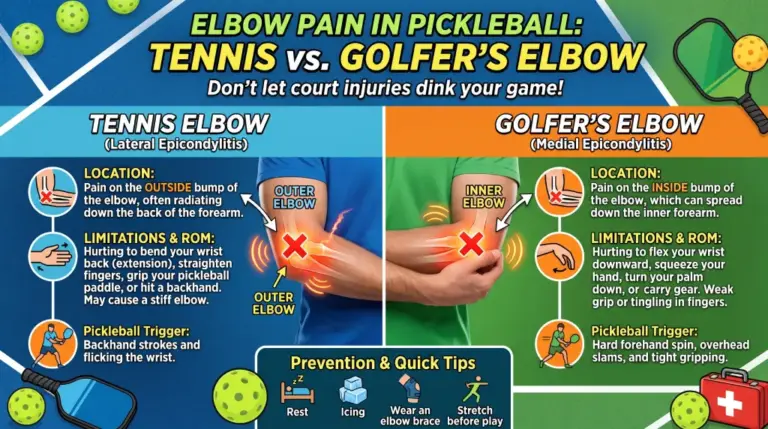
Tennis elbow, or lateral epicondylitis, is pain and tenderness over the bony bump on the outside of your elbow (the lateral epicondyle). It develops when the wrist-extensor tendons that attach there are overloaded by repetitive gripping, lifting, or twisting. The tendon doesn’t heal cleanly, so it degenerates and stays sore.
You’ll usually feel it when gripping a mug, turning a doorknob, typing, or lifting a grocery bag with your palm down. The pain can travel down the forearm, and your grip strength drops. The condition affects 1% to 3% of adults each year, most commonly between 35 and 50, and only 5% to 10% of cases are caused by tennis or golf (StatPearls, NCBI Bookshelf; Physiopedia, Lateral Epicondylitis). Painters, plumbers, desk workers, and new parents carry the load far more often.
If you want a plain-language walkthrough of the condition itself, start with our tennis elbow relief guide. The good news: most cases improve within a year with appropriate care. The less good news: symptoms can linger 6 to 12 months, roughly 4% to 11% of patients eventually need surgery, and many need other treatments when rest alone isn’t enough (Yao et al., BioMed Research International, 2020).
How shockwave therapy works for tennis elbow

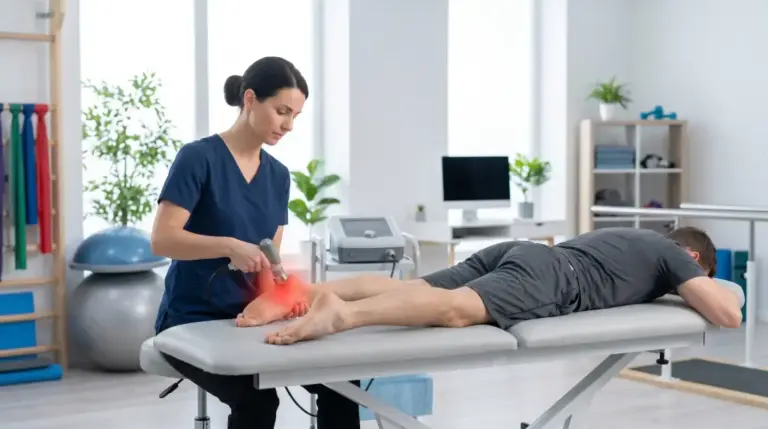
Shockwave therapy (also called extracorporeal shockwave therapy, or ESWT) delivers high-energy sound waves through a handheld applicator into the painful area at the elbow. The mechanical pressure of each pulse does three things the irritated tendon needs:
- It increases local blood flow and stimulates the growth of new small blood vessels, bringing oxygen and nutrients to tissue that has poor circulation to begin with.
- It temporarily raises the pain threshold in the treated area, which is why many patients feel relief early in a course of treatment.
- It interrupts the pain signals travelling from the tendon to the nervous system, a process called analgesic gating, so movement becomes less guarded.
Importantly, the studies behind shockwave therapy measure outcomes patients actually feel: pain scores and grip strength. Claims that shockwave “regenerates” the tendon are supported in lab and animal work, but human trials track symptom improvement. That’s still a meaningful result, and it’s the one we focus on in clinic.
Does the evidence support shockwave therapy for tennis elbow?
Yes, for the right patients. A systematic review and meta-analysis of randomized trials published in 2020 concluded that extracorporeal shockwave therapy effectively relieves pain and improves grip strength in lateral epicondylitis, and carries better overall safety than corticosteroid injection (Yao et al., 2020). Earlier pooled data showed accelerated early recovery on the Visual Analogue Scale for pain and on grip-strength testing.
Another clinical study split 50 tennis elbow patients into two groups: one received shockwave therapy, the other received standard care with anti-inflammatory medication, topical treatments, laser, and ultrasound. Both groups improved, but the shockwave group recorded greater improvement across all measured parameters. Pain relief was often felt after the first session, and the effect built over three to five sessions (Rogoveanu et al., Current Health Sciences Journal, 2018).
One nuance matters when choosing between radial and focused shockwave devices. A comparative study in Archives of Medical Science found that the duration of your symptoms can influence which technique responds better, so an assessment matters more than the machine brand (Stania et al., 2021). Your physiotherapist picks the modality and dose based on how long you’ve had the pain and how your tendon presents on examination.
What to expect from a shockwave session
At Pro Fusion Rehab, a shockwave appointment lasts 30 to 45 minutes. The physiotherapist locates the most tender point over the lateral epicondyle, applies gel, and passes the applicator over the area. You’ll feel a repetitive tapping or pulsing pressure. It’s uncomfortable during treatment, manageable without numbing, and most patients say soreness fades within a day or two.
Shockwave works best as part of a plan, not on its own. We combine it with other physiotherapy techniques:
- Interferential current (IFC) electrotherapy for pain control
- Heat therapy and soft-tissue manual therapy to relax the forearm muscles
- Progressive tendon-loading stretches and strengthening exercises, the cornerstone of long-term tennis elbow recovery
- Load-management advice so your daily work, gym, or sport stops re-injuring the tendon
Your physiotherapist reviews your progress regularly and adjusts the number of sessions to what your elbow actually needs.
Who should consider shockwave therapy?
Shockwave therapy suits you best if:
- You’ve had lateral elbow pain for more than 6 weeks despite rest, ice, or bracing
- Gripping and lifting still hurt, and your grip strength has dropped
- Injections or surgery feel like steps you’d rather avoid
- You’ve tried stretching alone and the pain kept returning
See a physiotherapist before assuming it’s tennis elbow. Elbow pain can also come from a pinched nerve in the neck, radial tunnel syndrome, or arthritis, and those need different treatment. A proper assessment takes minutes and saves you from paying for the wrong therapy.
Frequently asked questions
Does shockwave therapy for tennis elbow hurt?
Most people describe the pulses as strong tapping, uncomfortable but tolerable. The therapist adjusts intensity based on your pain during the session. Mild soreness after treatment usually settles within a day or two.
How many shockwave sessions do I need for tennis elbow?
Studies report meaningful improvement over a series of sessions, often three to five, spaced roughly a week apart (Rogoveanu et al., 2018). Your physiotherapist sets your plan around how your tendon responds rather than a fixed package.
How fast does shockwave therapy work?
Many patients feel pain relief during the first few sessions, with the effect building over the course of treatment. Combining shockwave with progressive exercise gives the most durable results.
Is shockwave therapy covered by insurance?
Many extended health plans in Ontario cover registered physiotherapy sessions, which may include shockwave depending on your policy. Check your coverage, and ask our front desk about direct billing for your plan.
Book a shockwave assessment in Pickering or Milton
If elbow pain is stealing your grip, come see us. Pro Fusion Rehab offers shockwave therapy at our Pickering physiotherapy clinic (905-492-2577) and our Milton physiotherapy clinic (289-878-8881). Licensed physiotherapists trained on the equipment will confirm your diagnosis first, then build a plan around your elbow, not a sales target. Contact us or book your appointment online, and start your recovery today.
Reviewed by the Pro Fusion Rehab physiotherapy team. This article is general education, not a diagnosis. See a licensed clinician for personal medical advice.
References
- Yao, G., Chen, J., & Duan, Y. (2020). Efficacy of Extracorporeal Shock Wave Therapy for Lateral Epicondylitis: A Systematic Review and Meta-Analysis. BioMed Research International, 2020, 2064781. https://pmc.ncbi.nlm.nih.gov/articles/PMC7106907/
- Rogoveanu, O.C., Mușetescu, A.E., Gofiță, C.E., & Trăistaru, M.R. (2018). The Effectiveness of Shockwave Therapy in Patients with Lateral Epicondylitis. Current Health Sciences Journal, 44(4), 368–373. https://pmc.ncbi.nlm.nih.gov/articles/PMC6421473/
- Stania, M., et al. (2021). A comparative study of the efficacy of radial and focused shock wave therapy for tennis elbow depending on symptom duration. Archives of Medical Science. https://www.archivesofmedicalscience.com/A-comparative-study-of-the-efficacy-of-radial-and-focused-shock-wave-therapy-for,102255,0,2.html
- Buchanan, B.K., & Varacallo, M. Tennis Elbow (Lateral Epicondylitis). StatPearls, NCBI Bookshelf. https://www.ncbi.nlm.nih.gov/books/NBK441974/