Book Appointment Now

Lymphatic Drainage Massage VS Manual Lymphatic Drainage (MLD)
The Wellness Approach: Lymphatic Drainage Massage
The term “lymphatic drainage massage” is frequently used in general wellness circles, day spas, and holistic health contexts. It typically refers to a full-body relaxation treatment designed to support overall wellness, reduce minor fluid retention, and alleviate abdominal bloating.
While it feels deeply relaxing and promotes systemic circulation, a standard lymphatic massage follows generalized, broad-stroke patterns. It is an excellent choice for individuals without complex medical diagnoses who are simply looking to reduce seasonal fluid retention, support their immune system, or decrease minor swelling from long-distance travel.
The Clinical Standard: Manual Lymphatic Drainage (MLD)
In contrast, Manual Lymphatic Drainage (MLD) is an advanced, medically regulated physical therapy intervention. Developed by Dr. Emil Vodder in the 1930s, true MLD is a scientifically rigorous protocol that requires a deep understanding of lymphatic anatomy, micro-circulation pathways, and specific tissue “watersheds.”
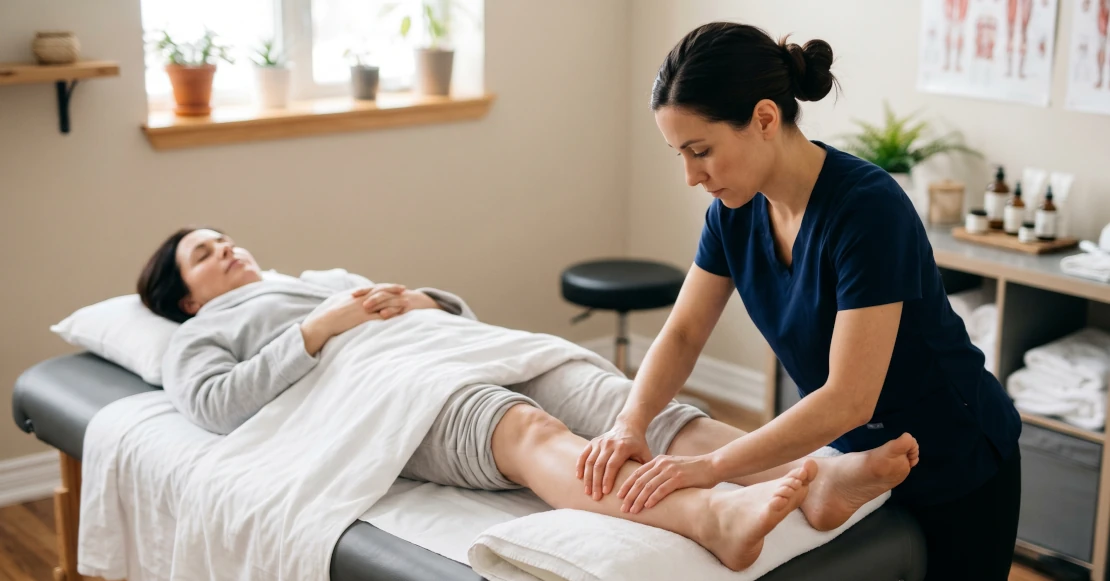
MLD consists of precise, repetitive movements—such as stationary circles, pump strokes, scoop strokes, and rotary movements—applied to the skin. The therapist applies just enough pressure (~15 to 30 mmHg) to gently stretch the superficial skin layers where the initial lymphatic capillaries reside.
Crucially, MLD is not a full-body routine; it is an individualized treatment mapped directly to a patient’s pathology, designed to mechanically reroute stagnant interstitial fluid around damaged or missing lymph nodes toward healthy, functioning drainage pathways.
Clinical Comparative Matrix:
| Core Question | Direct Answer | Comparison to Standard Modalities |
| What is the difference between Lymphatic Massage and MLD? | Lymphatic massage is a broad wellness treatment for general fluid stagnation, while MLD is a strict, medically mapped clinical technique targeting specific lymphatic watersheds. | Unlike deep tissue work, both utilize extremely light pressures (~15 to 30 mmHg) to stretch the skin without collapsing delicate initial lymph capillaries. |
| Is MLD effective for post-surgical swelling? | Yes. Clinical data shows that early intervention with MLD accelerates post-operative recovery, minimizes scar tissue adhesion, and significantly reduces localized edema. | Traditional massage is contraindicated post-operatively over healing incisions, whereas MLD safely reroutes fluid away from injured tissues. |
| Who is qualified to perform clinical MLD? | Clinical MLD must be performed by a Registered Massage Therapist (RMT) or Physiotherapist with specialized, post-graduate certification in the MLD techniques. | Spa-level lymphatic drainage rarely utilizes correct anatomical directional mapping or specialized skin-stretch protocols. |
How MLD Differs from Deep Tissue Massage
A common misconception among patients looking for therapeutic care is that MLD is simply a light variant of standard Swedish or deep tissue massage. Clinically, the two approaches are entirely distinct, and applying deep pressure to a congested lymphatic system can actually be counterproductive.
| Technical Attribute | Manual Lymphatic Drainage (MLD) | Deep Tissue / Classical Massage |
| Target Tissue | Superficial dermis and initial subcutaneous lymph collectors. | Deep muscular layers, myofascial planes, and trigger points. |
| Applied Pressure | Extremely light (typically 15 to 30 mmHg); enough to stretch the skin without depressing sub-dermal layers. | Moderate to heavy; designed to deform muscular tissue and release structural adhesions. |
| Directionality | Dictated entirely by anatomical lymph watersheds; always moves from proximal areas to distal, then drains back. | Broadly follows venous return lines toward the heart, but allows multi-directional strokes over muscle bellies. |
| Skin Contact | Performed dry or with minimal lotion to maximize skin traction and directional stretching. | Utilizes oils, emollients, or heavy lotions to reduce surface friction and allow smooth gliding over deep tissues. |
Accessing Expert Care: The Treatment of Both MLD and Lymphatic Massage Therapy in Milton, Ontario
For local residents looking for authentic therapeutic solutions, Pro Fusion Rehab’s specialized multi-disciplinary clinics deliver certified, evidence-based care. Our advanced Milton clinic features both fully licensed Physiotherapists and Registered Massage Therapists (RMTs) who hold post-graduate certifications in Manual Lymphatic Drainage. Having this diverse clinical team allows us to offer both specialized wellness lymphatic massage therapy and medical-grade Manual Lymphatic Drainage (MLD) under one roof, tailoring the intervention directly to your recovery goals.
Every initial session begins with a comprehensive medical history review and structural tissue mapping. The therapist always initiates treatment proximally—clearing the base of the neck and deep abdominal nodes first to “uncork” the central drainage pathways—before moving distally to clear the affected limbs. Whether you are recovering from an acute sports injury or managing long-term swelling, our certified clinical team creates an optimal environment for tissue healing.
Frequently Asked Questions
Q: Is manual lymphatic drainage (MLD) painful?
No, true MLD is entirely painless and deeply relaxing. Because the superficial lymphatic capillaries are incredibly delicate and thin-walled, applying moderate or firm pressure would immediately collapse them, preventing any fluid clearance. The pressure used during MLD is exceptionally light—just enough to gently stretch the skin.
Q: How soon after surgery can I begin MLD sessions?
With medical clearance from your surgeon, gentle MLD can often begin within 24 to 48 hours post-operation. Early treatments do not touch the active incision sites; instead, the therapist works on the proximal, uninjured lymphatic quadrants to create a vacuum effect that draws fluid away from the surgical site, safely reducing early-stage swelling.
Q: Do I need a doctor’s referral to receive MLD in Ontario?
While a physician’s referral is not required to see a Registered Massage Therapist or Physiotherapist for manual lymphatic drainage (MLD) in Milton, Ontario, many extended healthcare insurance plans require a medical prescription to process your reimbursement claims. We always recommend checking your specific policy details prior to your initial clinical visit.
Q: How many sessions of manual lymphatic drainage are typically required to see results?
For acute post-surgical swelling or orthopedic injuries, significant changes are often noted within 3 to 5 consecutive sessions. For long-term conditions like secondary lymphedema or chronic venous insufficiency, a patient will typically go through an intensive phase of 2 to 3 sessions per week for a month, followed by long-term maintenance care every few weeks, paired with a personalized home exercise program.
Q: Why is the pressure used during an MLD session so light?
The initial lymphatic capillaries are located just below the epidermis in the superficial layer of the skin. They are highly delicate, thin-walled structures. If a therapist applies moderate or heavy pressure, those micro-vessels immediately collapse, preventing them from absorbing fluid. Light pressure is anatomically required to gently stretch the skin sideways, which pulls open the microscopic entry valves of the lymph capillaries without closing the vessel itself.
Q: Can I perform lymphatic drainage massage on myself at home?
Simple variations of self-lymphatic drainage can be very effective for maintenance care, but they should only be performed after you have been properly trained by a certified therapist. Attempting self-treatment for complex conditions like post-oncological lymphedema without proper clinical mapping can accidentally push fluid into blocked anatomical zones, worsen local swelling, or overstrain compromised tissue areas.